The express train from Kanazawa to Kyoto, the Thunder Bird Express, was fast and comfortable, not as fast as the Shinkansen but we still took only 2 hours and 20 minutes to travel the 230 km. For about 90 km the track is beside the huge Lake Biwa (Biwako in Japanese) so that added some interest to the trip.
At Kyoto we walked around the streets for an hour or so while waiting for check-in time then settled in at the hotel before spending a couple of hours at a local laundromat. Even tedious stuff like laundry can be interesting when being helped by local people who are quite happy to explain how the machines work.

Eating noodles in soup is much cleaner when the restaurant supplies a paper bib.
It was great to see Mieko and Yuichiro Hirose again, after 10 years. Although we can’t speak Japanese and their English is limited we still manage to enjoy each other’s company. We went north by train to a ropeway (cable car) that took us up about 1000m to a lookout and restaurant where we spent a couple of hours looking at the view, waiting in the queue for lunch, then eating a light lunch. Biwako is huge, supplying most of the water used in Kyoto, Ōsaka and Kobe from one main river.

Overlooking Biwako on a cloudy day
After the return trip to Kyoto station we took another short ride to Fushimi Inari Shrine, one of the most interesting shrines we have seen. Inari is the God of rice, so imagine how many Inari shrines there are in Japan. The Inari Shrine at Fushimi is the most important so it receives thousands of visitors every day. It’s main Gate and main building are impressive but about 4 km of smaller bright orange gates, set about 150mm apart, make it really interesting.

The entrance to the Inari Shrine
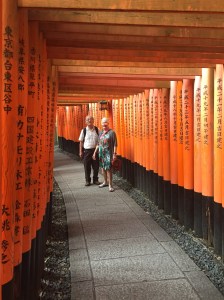
It takes about 2 hours to see all the thousands of gates; we didn’t see them all.
Dinner that night was amazing; a delicious tepanyaki meal at a hotel adjacent to the Kyoto station, with a view of the Kyoto Tower.
Next morning we met Mieko and Yuichiro again and walked across the road to the Tokyo Tower, with an observation floor 100m high showing great views of the city, surrounded by mountains. We saw the Shinkansen (Bullet Train) arriving at the station, the one we would catch the next day (there are dozens each day but of course the one we saw must be ours). The Hirose’s proudly showed us their home town from above, on a clear day.

From the Kyoto Tower; see the Shinkansen pulling into the station.
Using a local bus we visited the Kitano-tenmangu Shrine, especially interesting because on the 25th of each month it operates as a flea market, occupied by hundreds of small stalls with vendors selling a huge range of food, souvenirs, craft, textiles and second hand products. This was followed by a light lunch in a tiny local guest house. 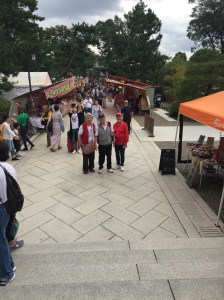
As it started to rain we took a taxi across town to Heianjingu Shrine, famous for its beautiful gardens. The rain stopped while we wandered around, enjoying the peaceful grounds with dozens of different plants and reflecting pools.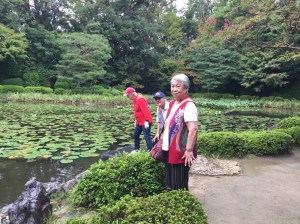

Enjoying the serenity
Back at Kyoto Station we went up 11 escalators to a Tempura restaurant and enjoyed another really good meal. The Japanese certainly know how to turn simple fresh produce into incredible food that looks and tastes wonderful.
Feeling exhausted and full we returned to our room to pack for the next phase of the holiday, a few days in Tokyo. We will travel by Bullet Train, the Shinkansen, taking about 2 hours 20 minutes to go about 450 km; looking forward to that.
 Ted and Jo