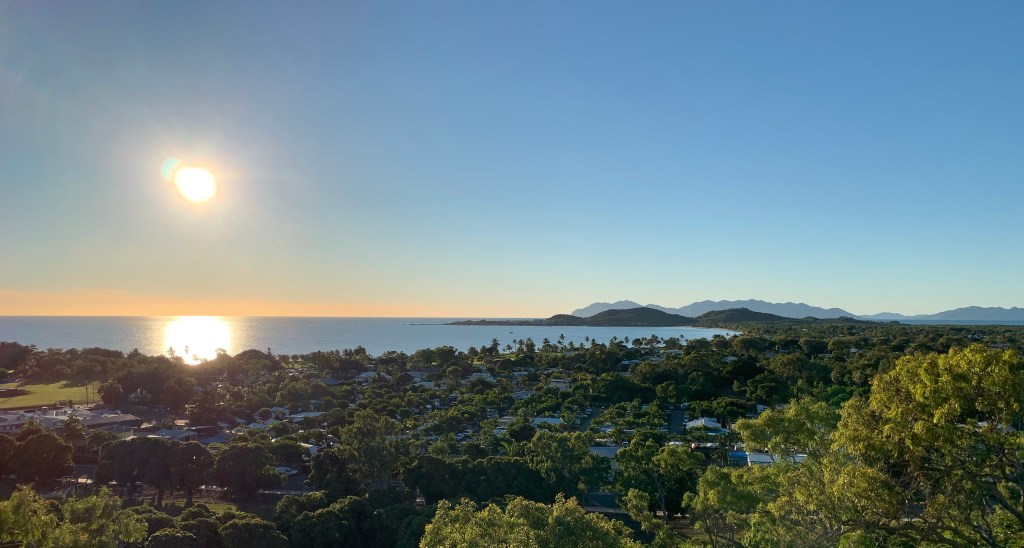
In the 15 days since leaving Cape Hillsborough we have visited Bowen (5 nights), Burdekin Farm Stay (3), Townsville, (2) and now we are at Rollingstone Beach (5).
On the way to Bowen we almost got run off the road by 2 road trains tailgating each other. It was very scary our good car and caravan set up allowed us to brake without losing control. We had a non-powered site in Bowen’s Wangaratta Caravan Park and we thought it was the best in the park, sunny and shady areas, no close neighbours and easy walking distance to the beach. A highlight at Bowen was seeing Where the Crawdads Sing in a very small theatre that has been in operation since the 1940’s and is maintained close to original condition.
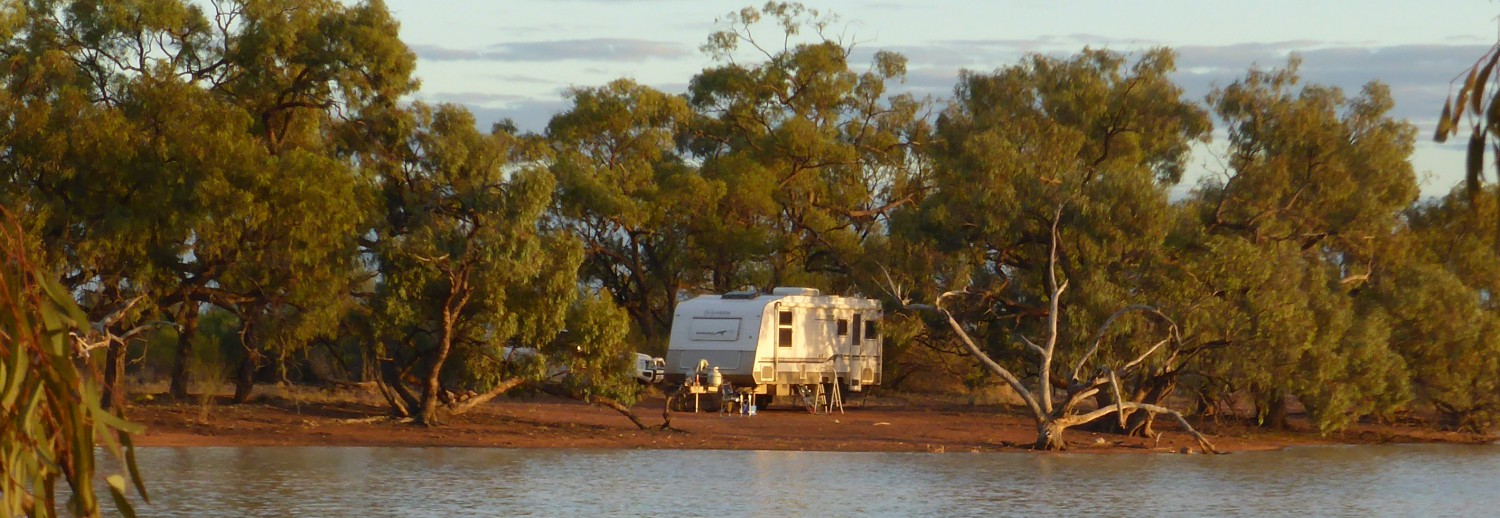
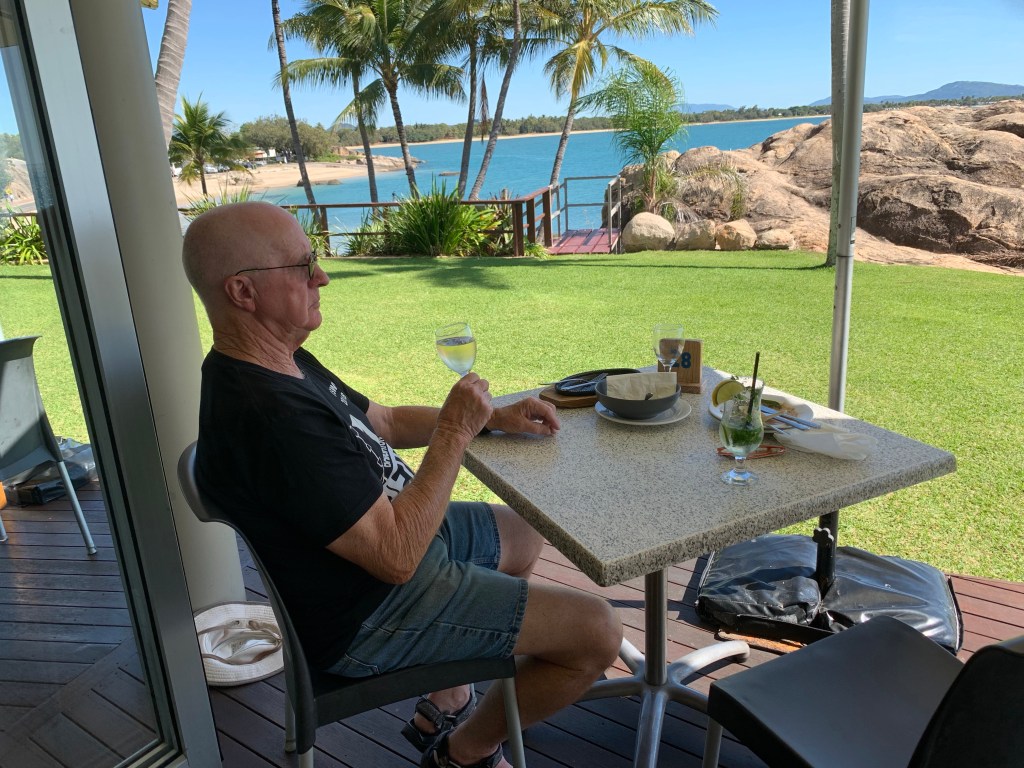
Our camp site at Bowen.Roughing it at a beachside restaurant in Bowen.
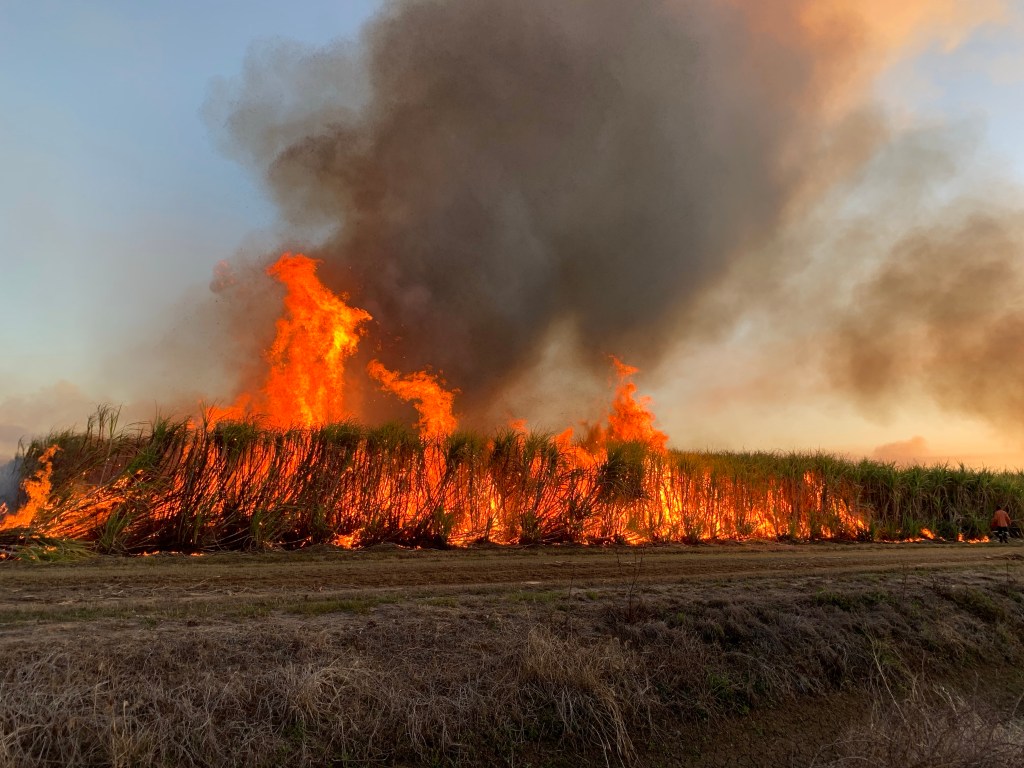
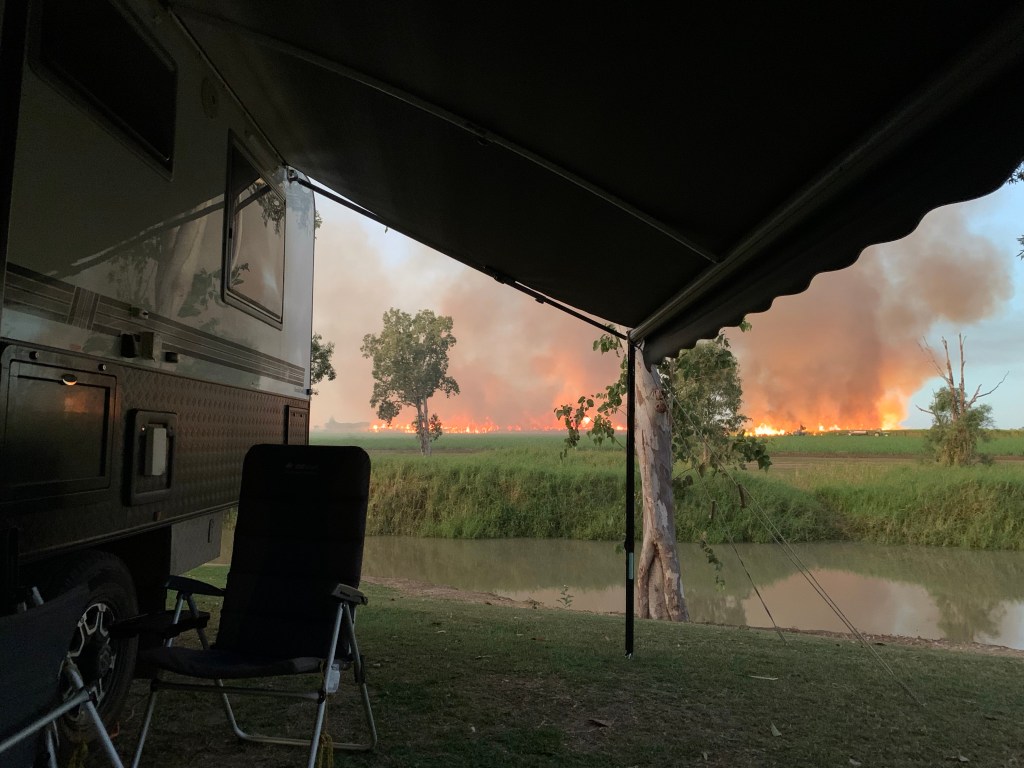
The Burdekin Farm Stay was a highlight of the trip so far. Just a few km from Ayr and about 30 km from the coast, we were surrounded by cane farms. Our site was on the bank of a creek running through the property, with green grass, mango trees covered with flowers and with just a few other campers. It was exciting to see cane burns then harvesting the burnt crops; also surprising because we didn’t realise that cane burning still happened. The Burdekin region is one of only two areas that still allow burning.
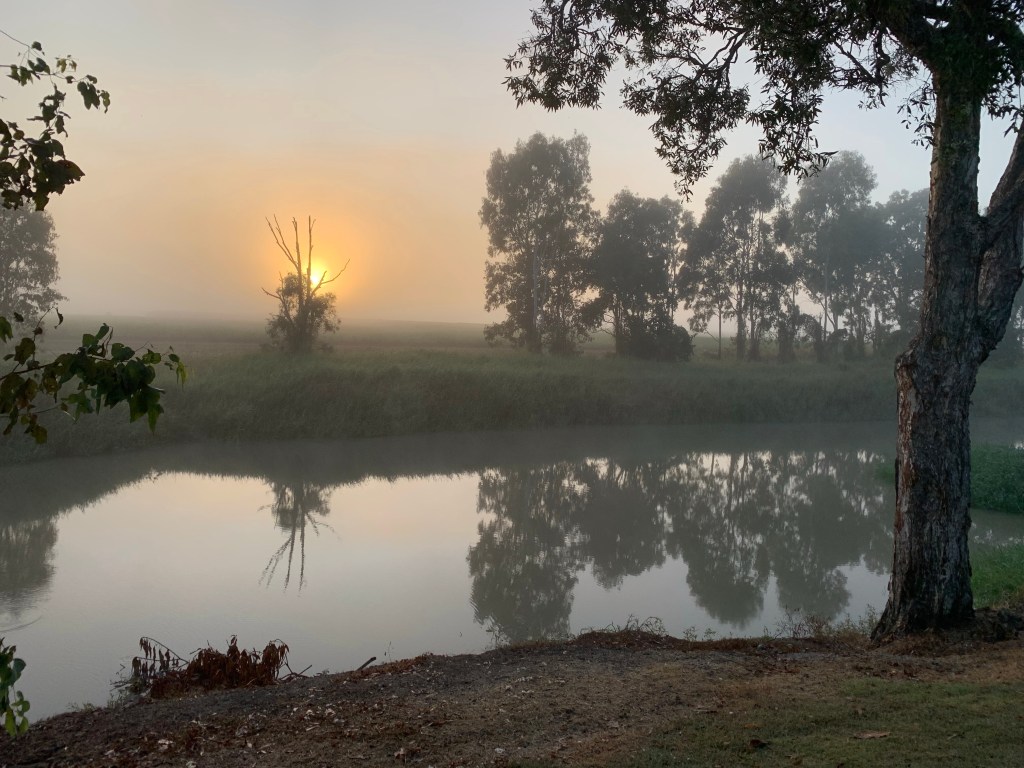
The fires moves really fast and when standing this close the heat is intense.Although fires were everywhere it ,was not frightening because they are well managed. There was ash everywhere, so things got a bit dirty.A surprise benefit of the fires was sunrises like this.An afternoon snack with new friends at the Farm Stay.
Townsville was mainly an opportunity to re-stock and do the laundry after a few days in the bush and before the short drive to Rollingstone Beach Caravan Resort.
Located on the coast just a few km off the highway Rollingstone is more of a bush caravan park than a resort. It has a nice swimming pool, a jumping pillow, a dirt bmx track, a bar/cafe that’s open four afternoons a week but it’s best feature is the park layout. There are about 150 van sites and a few cabins spread over a very large grassed area, either along the beach front or around a marina-lake. Many of the sites are quite large. The beach is not particularly nice but the sound of waves is relaxing. Generally, it’s a good place to stay for a few days.
Our spacious site beside the lake.
Today has been busy. It’s our last day at Rollingstone so we treated ourselves to a hamburger for lunch and will have pizza for dinner, with cocktails and wine. We had intended going north to Mission Beach tomorrow but there is rain expected for the next week so we will go inland to Charters Towers instead. We did go there about 10 years ago and are quite looking forward to returning.
As usual, we hope everyone keeps safe and well. Bye from North QLD.
What a life! This morning we are sitting in the sunshine with the temperature at 23 degrees, following an overnight minimum of 15 deg. Sorry to brag about it, for those stuck in the southern states.
After a nice few days with friends in Airlie Beach we backtracked for 160 km southward to Mackay, to see more friends there. It was fun to catch up with them again. The kids are 7, 5 and 4 years old and to watch them playing soccer and golf at that age was great. We are lucky to have had such generous hosts in both Airlie Beach and Mackay.
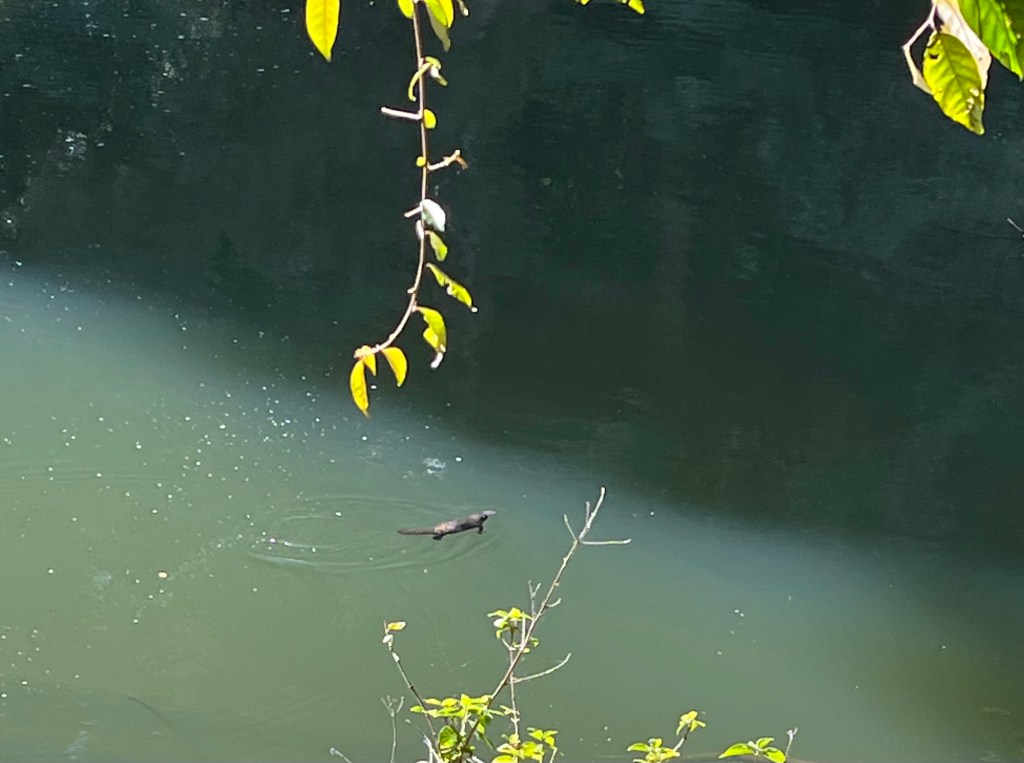
Sixty km inland (west) of Mackay is the nice little town of Finch Hatton, big enough to have a pub, a general store and a Showground that doubles as a caravan park. With power, water, green grass and heaps of space, it’s a really nice place to stay for a few nights. During the day we visited the nearby Eungella National Park and at night chatted with fellow travellers around our campfire. The National Park is mountainous, with rain forests and fast flowing creeks that are occupied by platypuses (yes, that’s how to say the plural of platypus). It’s beautiful, although at 4 degrees, the nights were cold.
Rain forest in Eungella National Park.Proof that we saw a platypus. They are smaller than the southern species.From Eungella to the sea, 80 km of cane fields in the valley.
From Finch Hatton to Cape Hillsborough was only 80 km, at first through cane fields then through pretty, hilly, farm land and forest. We stayed here last year and enjoyed it so came back again. The caravan park within the national park is the only developed facility for several kms so the beach and bush walks are not very busy. It is very relaxing. Wallabies, kangaroos and kookaburras are at home amongst the caravans and motor homes.
Feeding time at dawn. A noisy neighbour, ready to swoop on unattended food.The caravan park is amongst the trees on the flat ground to the left.
Tonight, being Friday, is pizza night so we will enjoy a social evening with neighbours before heading north to Bowen tomorrow morning.
We hope everyone keeps happy and well. From Ted and Jo.
Eleven days later after leaving Cobar we are in Airlie Beach. The weather has been pleasant, with cold nights (between 2 and 9 degrees) and fine days (between 22 and 25 degrees). The roads have varied between very bumpy and quite good, mostly bumpy. With light southerly breezes or no wind at all, travelling has been easy and fuel consumption quite good. The new vehicle has performed very well.
A lot of rain fell over a large area of outback Queensland last week and we just missed it by 2 days. All the way from Bourke to Barcaldine there has been water everywhere in the roadside ditches and paddocks, as far as the eye can see. Creeks and rivers have been swollen and it’s good to think that some of the water will reach South Australia. In places where we would normally be able to pull off the road to have lunch or collect firewood, this year we couldn’t . Although we haven’t been directly affected by the rain we have seen and heard about places where people have had to be towed out of muddy conditions.
Along the way we spent 2 nights in Cunnamulla, at one of our favourite caravan parks, one night at Wyandra, one at Augathella, three at Lara Station wetlands, one at Theresa Creek Dam and one at a roadside rest area before arriving at Airlie Beach.
Happy hour at Wyandra, free camping behind the local school.Sunrise over the thermal pool at Lara Station wetlands.Our caravan at the far left, Lara Station wetlands.
We have been at Airlie Beach for a couple of days, enjoying time with friends who live here. Nights are 14 deg and today has been 27 deg. – very comfortable and good for swimming. Airlie is beautiful, with blue water, green hills, sandy beaches, modern buildings, and of course lots of tourists.
Tropical waters in the harbour at Airlie Beach.
We will leave here in a couple of days, heading for Mackay to spend a few days with friends. It’s a great life.
It’s a couple of months later than normal but we are on our way at last, heading to Far North Queensland via Victoria. If the intention is to get to a warmer climate as soon as possible why would we travel to Victoria first? It’s because of our new car so, be warned, this first blog is mainly about the car.
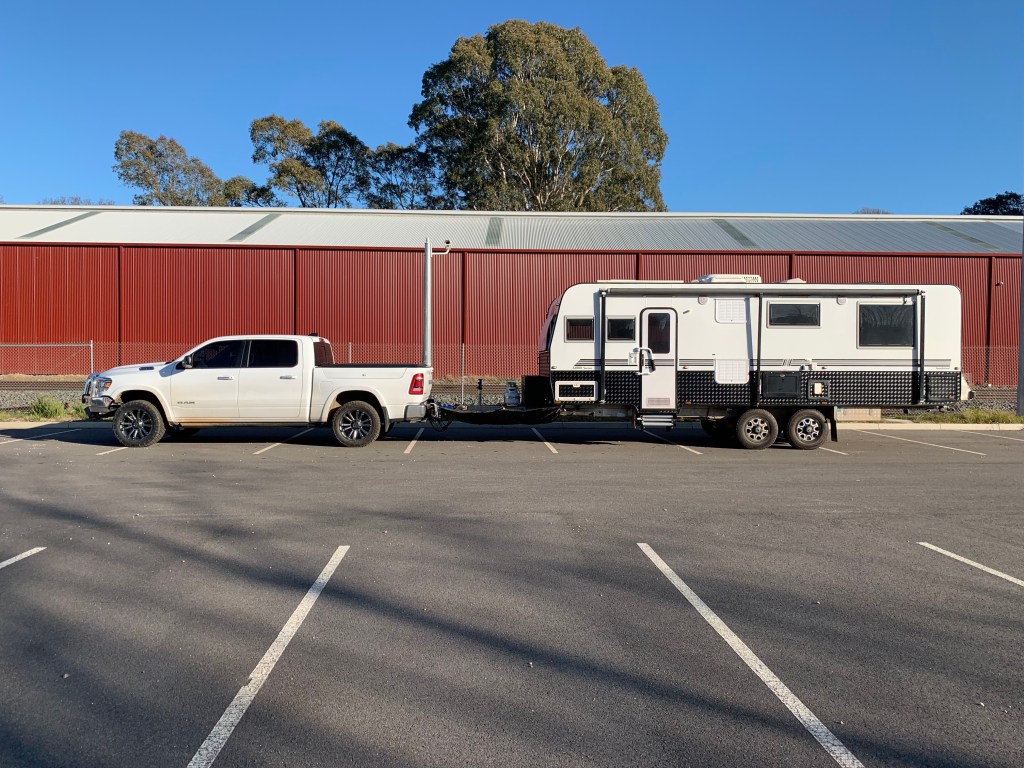
After our 2021 trip we decided to upgrade our tow vehicle so we sold our 12-year old Landcruiser 200 and bought a RAM 1500 DT, taking delivery in February 2022. It’s a very comfortable, modern touring ute and quite different to anything we have had before.
Pre-purchase research revealed that we would need some upgrades to do what we want it to do. In particular we need a bull bar, long range fuel tank and suspension upgrade. The bull bar and fuel tank add extra weight, meaning that the RAM would be over weight so we need a Gross Vehicle Mass (GVM) upgrade to remain legal. The suspension upgrade is also needed because the weight of the fully loaded vehicle and the Tow Ball Mass (TBM) causes the back of the RAM To drop and the front to rise, both by about 60 mm.
Pre-upgrade: the RAM is too low at the rear.
Two logistical problems existed; firstly the closest licensed GVM upgrader for our model RAM is in Castlemaine, Vic and secondly there is a 3 to 4 month delay in getting the parts. This meant a 2-day, 630 km trip from Adelaide to Castlemaine, where we have been for 3 days. The car is with the installer and it should be ready in a couple of hours for a test run, with and without the caravan.
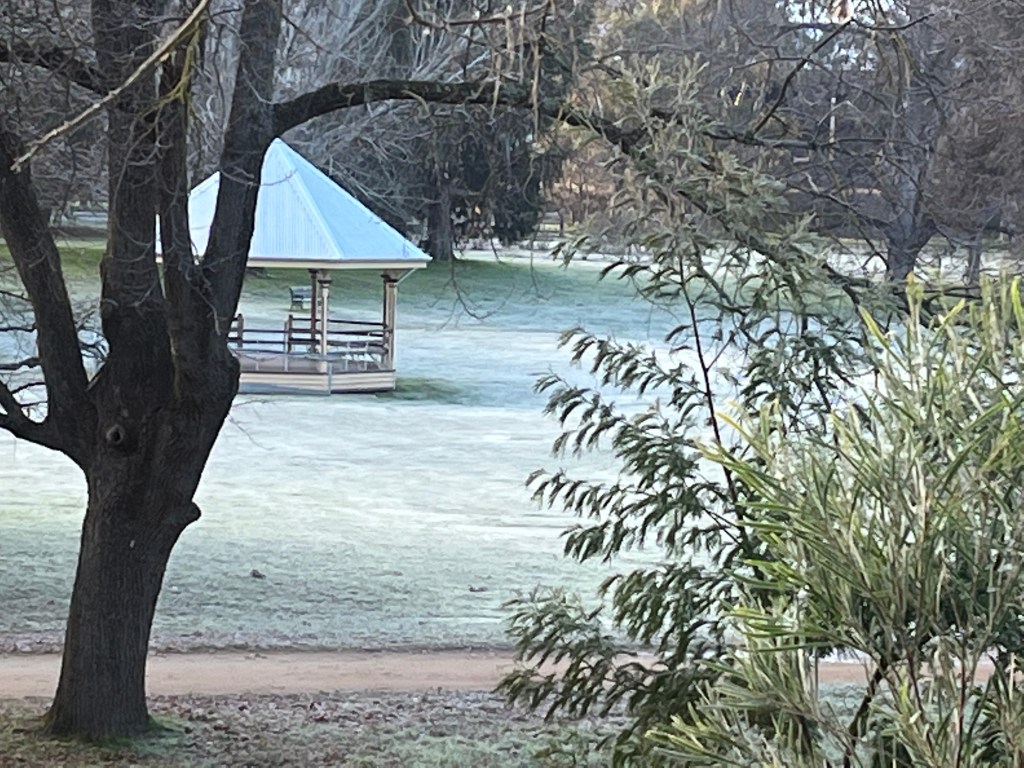
Castlemaine and it’s Big4 caravan park are quite nice – but the weather is freezing. This morning we awoke to -1 degree outside the van, frozen water hoses and frost everywhere. At least we have a heater in the caravan so we were comfortable inside. The clear, calm nights are followed by sunny days with a maximum temperature of 12 degrees.
A frosty morning in Castlemaine.
After waiting another 24 hours the car is finally ready, but too late in the day for a test run with and without the caravan. We allowed an extra day for just such a delay so we will do a test run tomorrow morning as we depart the caravan park.
Post-upgrade, the truck is level and with new rims and tyres it looks great.
The test run went well. Fully loaded, the RAM and extra fuel now weighs 3.6 tonnes, including 300 kg tow ball Mass (TBM), and the caravan (unchanged) weighs 3.6 tonnes, excluding the TBM. Our combined weight is therefore 7.2 tonnes. The RAM’s authorised GVM is now 3.8 tonnes, towing capacity is 4.5 tonnes and authorised Gross Combined Mass is 7.7 tonnes so we are legal.
Two days later we are in Cobar, well on our way north to sunny Queensland. Night temperature is 8 degrees and days around 20 degrees so we are feeling better already. Looking forward to seeing friends in Mackay and Airlie Beach.
That’s all for now. Hope everyone keeps well and happy.
Well Covid-19 has done it again. While at Cunnamulla, still in Queensland, we heard that South Australia had closed its borders to most of Australia, including Queensland. This means that we will have to self quarantine for 14 days on return to Adelaide. We had to wait a full week in Cunnamulla until our permit arrived by email.
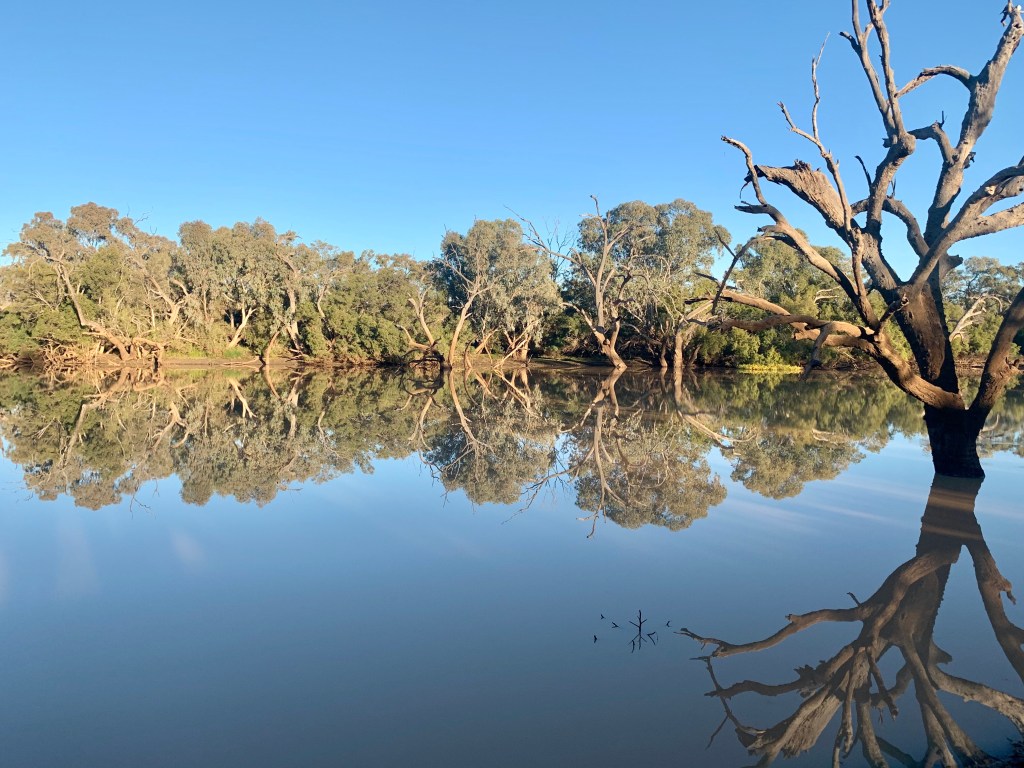
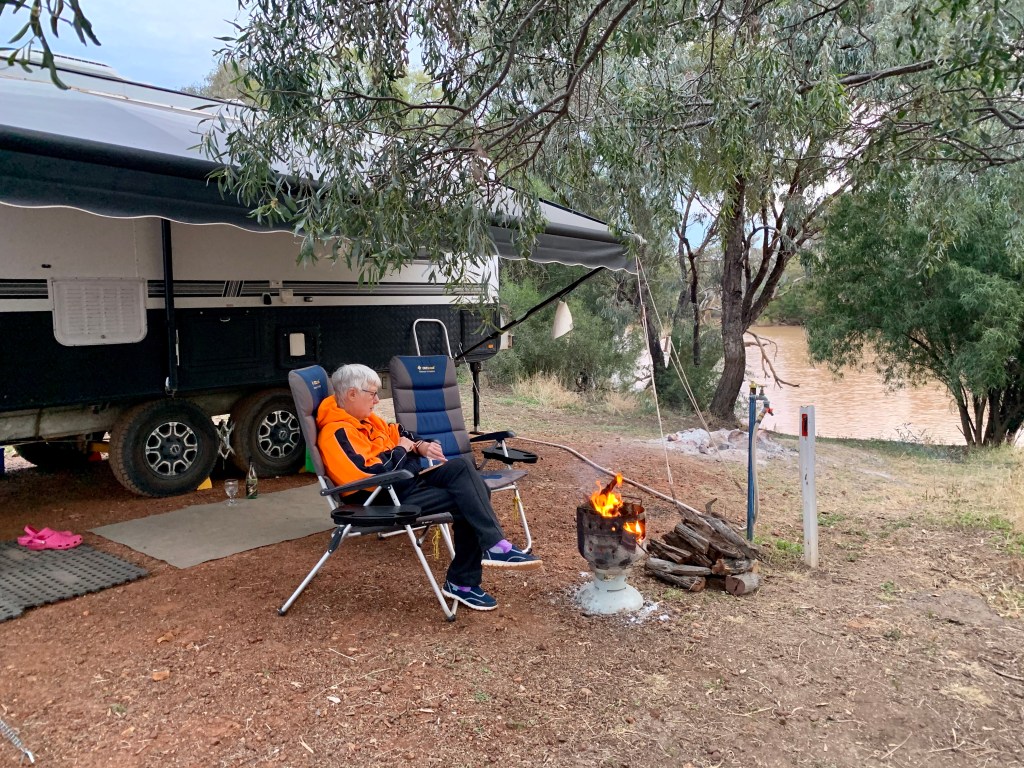
This was not a major problem because our 7-day camp site beside the Warrego River was very pleasant and the weather, although cold at night, was very kind to us.
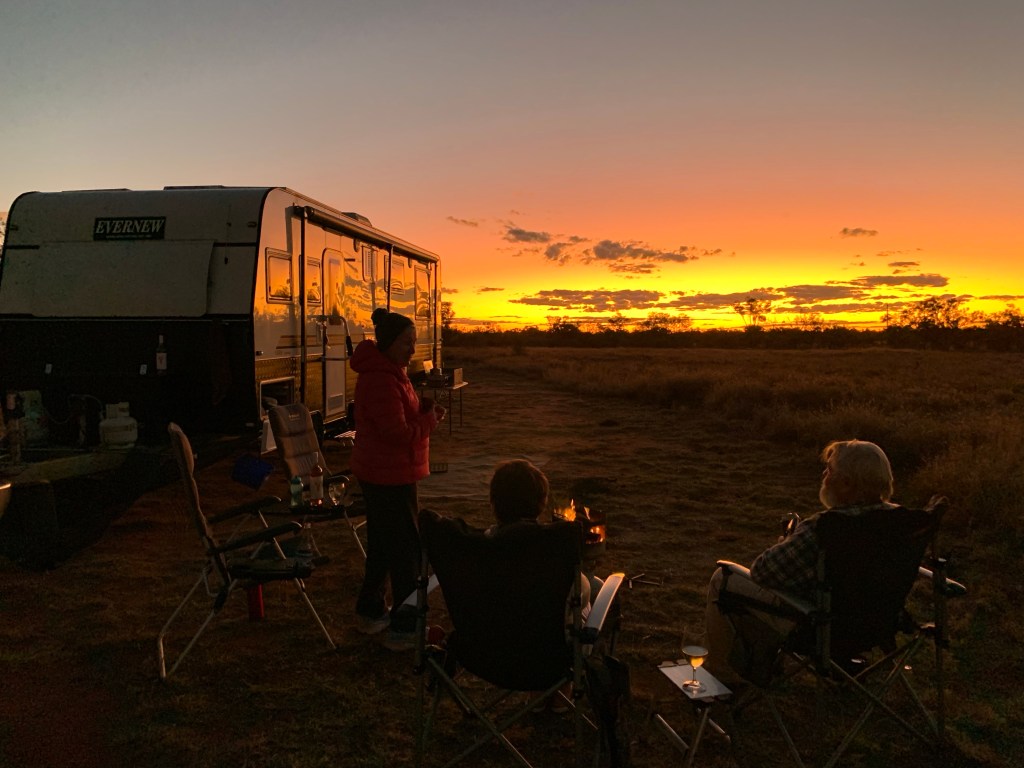
Early morning view from our caravan site at Cunnamulla.Our last evening at Cunnamulla – is it time for a wine yet?
From Cunnamulla we drove quickly through New South Wales; 260 kms to Bourke, 420 kms to Wilcannia, then 480 kms to Peterborough in SA. We had to go through a COVID checkpoint just out of Peterborough where we were reminded that we had to self quarantine at home and were told that, as expected, we could stay overnight at Peterborough and must return to Adelaide the next day. We could not stop at a park near Adelaide to clean the caravan, as we usually do. No problem; we are so lucky compared to people elsewhere in Australia and all over the world.
During this holiday we didn’t get as for as we would have liked and we didn’t stay away for as long as we had wanted – but we still had a good time, saw our friends in Qld and generally enjoyed caravanning life.
As usual, here are a few statistics for those who are interested (approximate figures). During the 57-day trip we travelled 7,800 km, being 6,900 km with the caravan and 900 km on side trips. We relocated the caravan on 26 days at an average of 265 km each time we moved; the van did 300 km or more on 12 days and less than 100 km on 4 days. We used 1,700L of diesel at an average cost of $1.43, making a total of $2,400, or $41 per day. Average fuel consumption was 22 L/100 (10% more than usual because we did fewer side trips without the caravan).
We arrived home yesterday and are now relaxing at home on day 2 of our lockdown. Everyone keep healthy and safe.
One good thing about caravanning is that we can be flexible. Before leaving Bowen we decided to go back toward Adelaide rather than continue northward. My shoulder is not recovering well from my injury last March so, after consulting my physiotherapist it will be best to consult the surgeon to have an operation as soon as possible.
Revisiting our friends in Airlie Beach and Mackay for a night each was a good way to start the return trip. By now we knew that COVID-19 was causing cross border trouble again but we could travel to SA through NSW as long as, in NSW, we stop only for essential needs, e.g. fuel, food, overnight rests. No problems while we are in Qld.
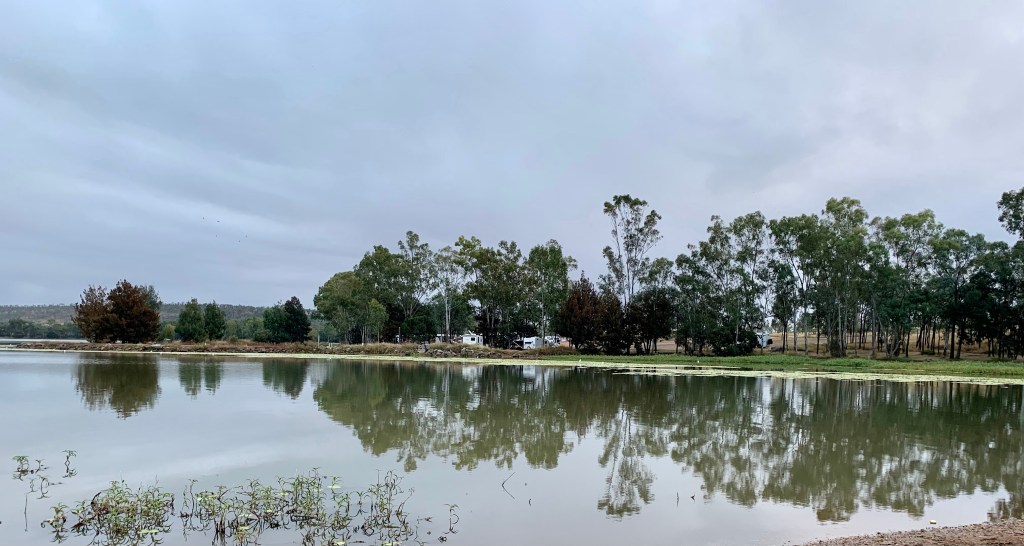
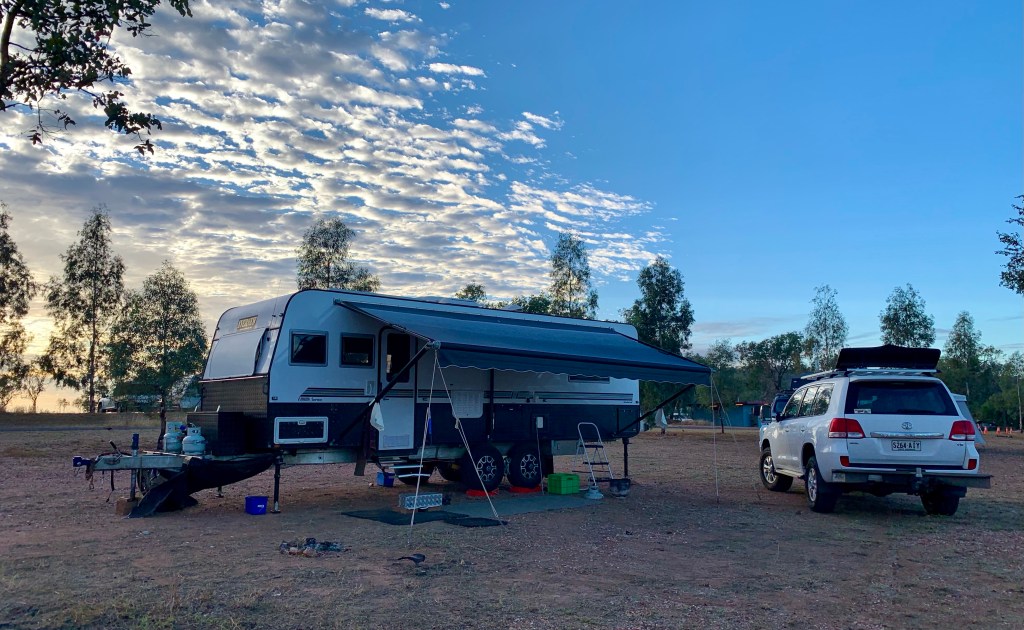
For several years Theresa Creek Dam, near Clermont, has been on our list of places to stay. It’s a very large camp site on the bank of a large dam, with room for 100 vans or more. After trying unsuccessfully for a secluded side we parked amongst the crowd. There was plenty of room but generators were a bit annoying during the day. Even so, it was a nice place to stay.
Theresa Creek Dam – we couldn’t get a waterfront site like these.Beautiful morning sky at Theresa Creek Dam.
Next stop was Bedford Weir, near Blackwater where we were to spend a couple of days with friends who live their. It was good to see M and K and their two young girls. By now we were right in the middle of serious coal mining country. Mines are everywhere, making interesting scenery during the day and spectacular light displays at night. Bedford Weir provides water skiing and fishing opportunities for locals and a quiet free camp for travellers passing through.
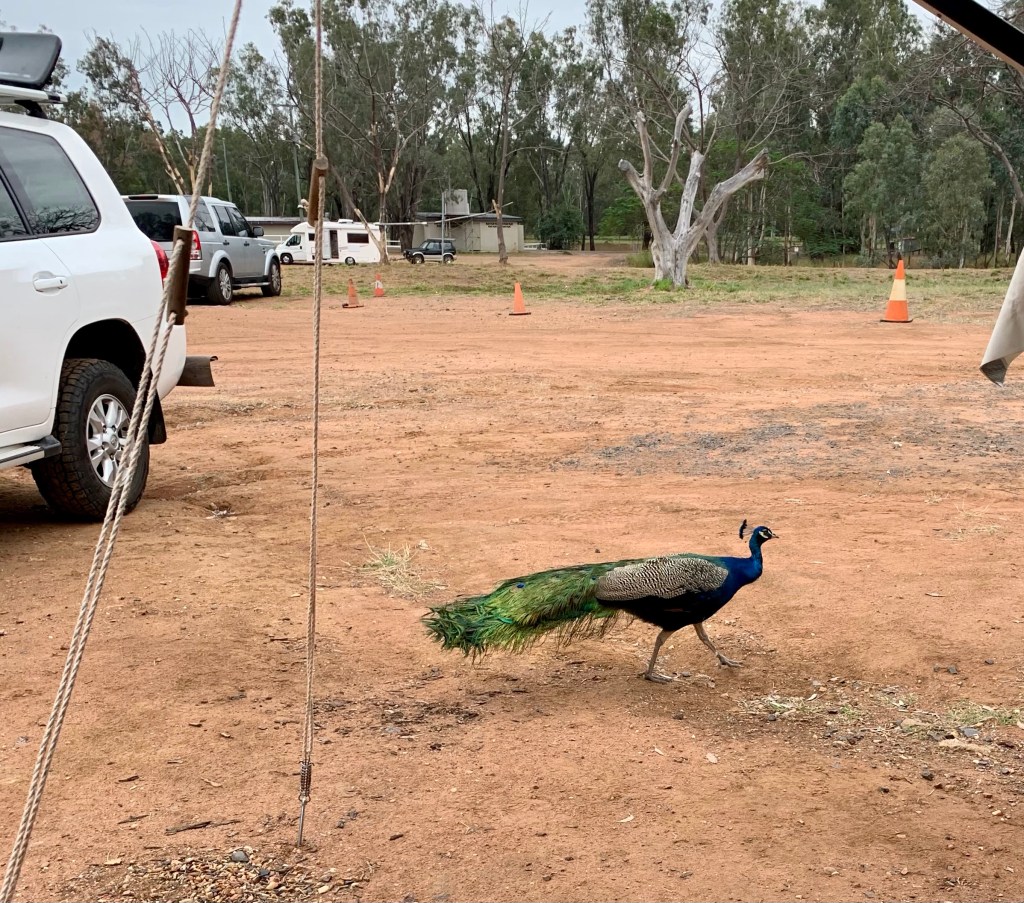
About 10 peacocks roamed freely amongst the vans at Bedford Weir.
Rain fell for several hours as we drove to Jericho, where we had planned to stop for a couple of nights if we could get a powered site, to do some laundry. Instead we stayed only one night because our site at the Showgrounds was not particularly inspiring. Besides we knew that friends from Renmark were getting close in their caravan so we decided to head for Augathella to meet them. It was great to catch up with them for a couple of evenings of fireside chatter, even if the temperature got down to 0 degrees at night.
Dressed for warmth at Augathella.
At Augathella we lodged our online application for entry into SA, then headed off to Cunnamulla. There were hundreds of vans on the road, either heading for the Big Red Bash at Birdsville, or just trying to escape from the cold and COVID-19 in the south. By now most Australian states had closed their borders and we knew that once we arrived in SA we would have to self-isolate for 2 weeks and get 3 Covid-19 tests. It also means putting off visiting the surgeon until the self-isolation period is over.
We managed to get a non-powered site at the Warrego Riverside Park just outside if Cunnamulla, with about 100 other vans, trailers and tents. We were camped on grey clay soil, recently cleared to allow for the influx of visitors. Local businesses told us they have never had so many visitors and getting fuel involved waiting on long queues. The bakery even ran out of coffee! The weather forecast for the second day was for rain over 24 hours so we changed sites as soon as soon as one on red gravel became available when people moved on. We got a nice site right beside the river, coincidently the same site we had stayed on a few years ago. The rain did come and people on the grey clay found it to be very muddy.
Beside the Warrego River, a good spot to wait for our entry passes.
As this update goes to post we still have not had approval to enter SA so we have decided to stay in Cunnamulla rather that become stranded somewhere in NSW. At this stage we plan on arriving home on about 8 July – but anything could happen.
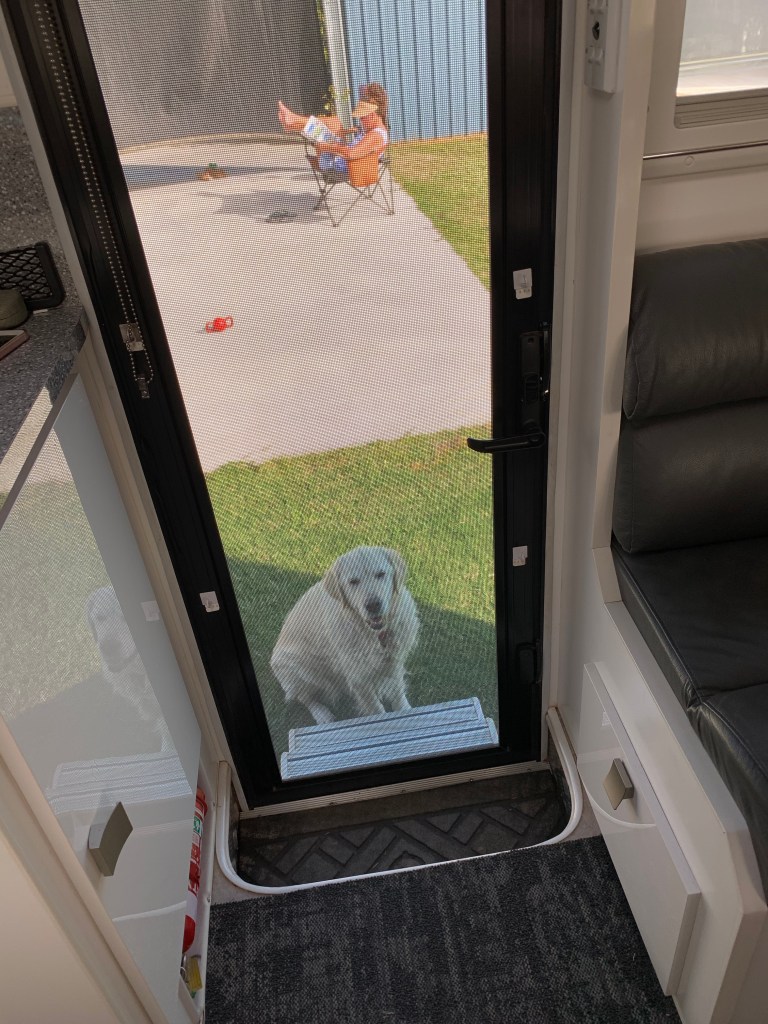
Airlie Beach was great. Friends we met on a cruise in 2018 live there and made us feel very welcome. On their large suburban block at Cannonvale, a “suburb” of Airlie Beach, they have a nice house which they rent out permanently, a large shed for their vehicles and a huge open shed for their 5th wheeler, with room for our van as well. With that arrangement they and their dog can be in Airlie Beach anytime they want or travel anytime they want. It’s a good life.
Our private caravan park at Airlie Beach.Our new friend, Mollie, couldn’t understand why she had to stay outside.
We did lots of sightseeing, eating, drinking and talking. Vanessa cooked wonderful meals and snacks (she must have thought we needed fattening) and Jim helped with a few caravan maintenance jobs.
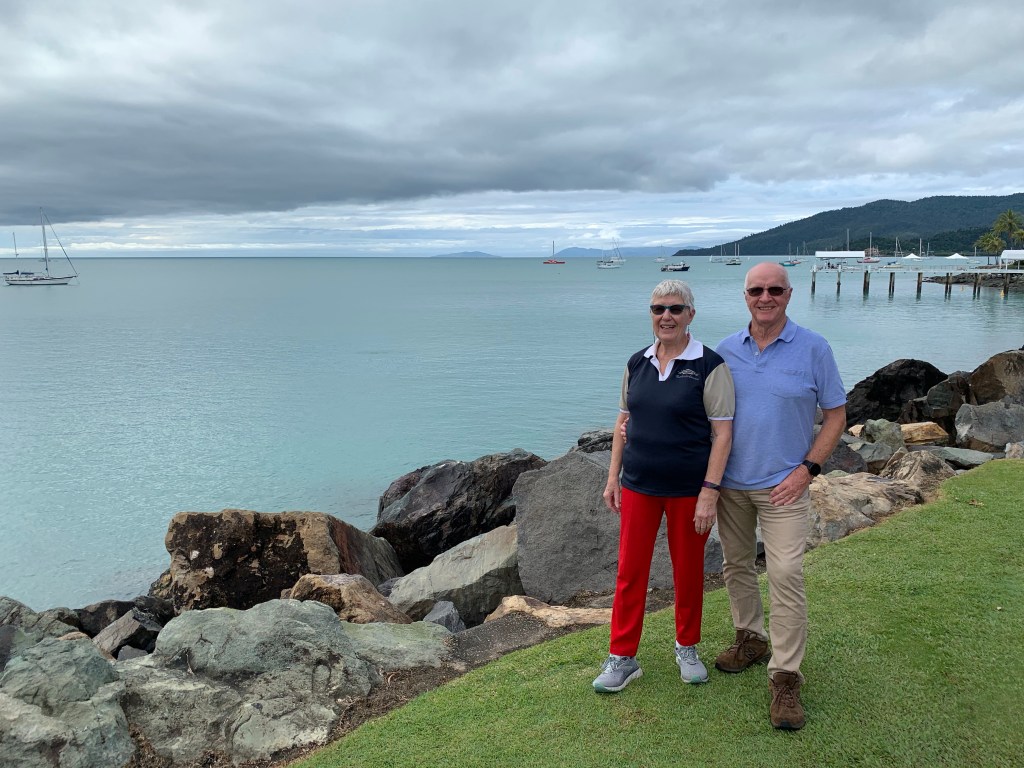
Airlie Beach sits beside a beautiful bay.Dressed for “cold” weather, maximum of 22 degrees.
About 80 km north, Bowen sits on a prominent headland that juts out into the smooth waters of the Whitsunday Islands. Although only 11,000 people live in Bowen the town covers quite a large area because of rocky outcrops, mangrove swamps and several remaining cane, fruit and vegetable farms.
Early morning at Queen’s Beach, with our caravan park in the left foreground.
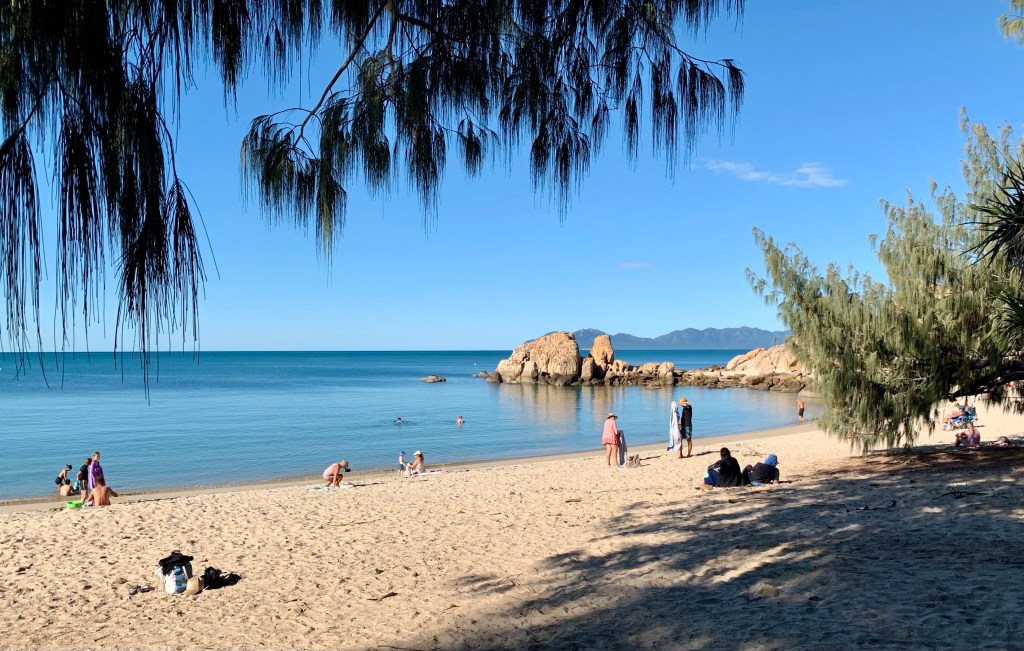
There is one beach about 4 km long and four much smaller beaches. Apparently crocodiles, although present in swamps, creeks and inlets, are not a problems on open beaches so we swam yesterday at one of the prettiest beaches we’ve seen, Horseshoe Bay. It’s only a couple of hundred metres wide, with clean sand, clear water, and large rocks at both ends of the bay that are home to quite a few corals and fish. With air temperature of 24 degrees and water temp of 23 degrees, it was an opportunity not to be missed – so snorkelling on a couple of days was good fun.
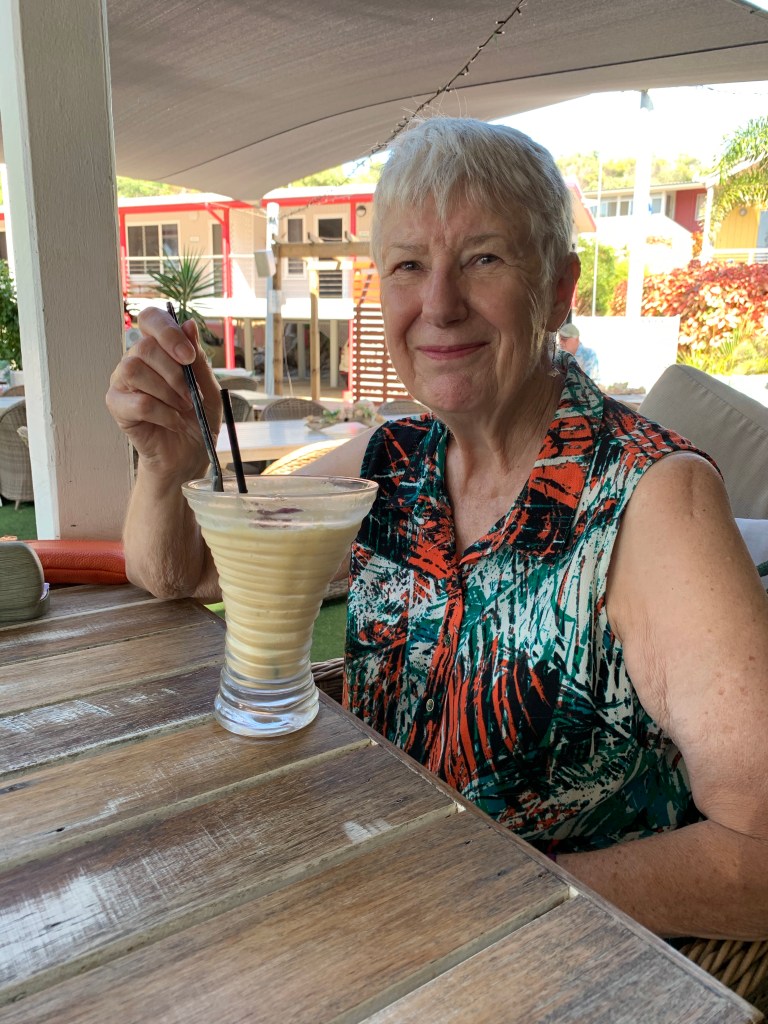
Beautiful Horseshoe Bay, quite good snorkelling.Also good for relaxing with a mango smoothie and lunch.
Tomorrow it’s time to head off again; not sure where but looking forward to it.
We are pleased to hear that Victorians now have reduced Covid-19 restrictions than when we posted out previous update but now New South Wales is in trouble. Obviously we need to keep pushing on with the vaccination program – we had our first one before leaving home and are due for the follow-up in July.
As always we hope everyone keeps healthy and safe.
Can’t believe that it’s almost 2 weeks since our last update. Where does the time go? We are now at Cape Hillsborough, about 60 km north of Mackay and, looking back on it, we have been quite relaxed for that time.
We stayed at Hervey Bay for 3 nights, doing not much but laundry, shopping and having lunch out. One restaurant, Water’s Edge, was very nice, with a range of very interesting seafood options. We didn’t know how big Hervey Bay was but there are 23 caravan parks in and near the city so it’s quite large.
Lunch decisions are difficult at Water’s Edge.
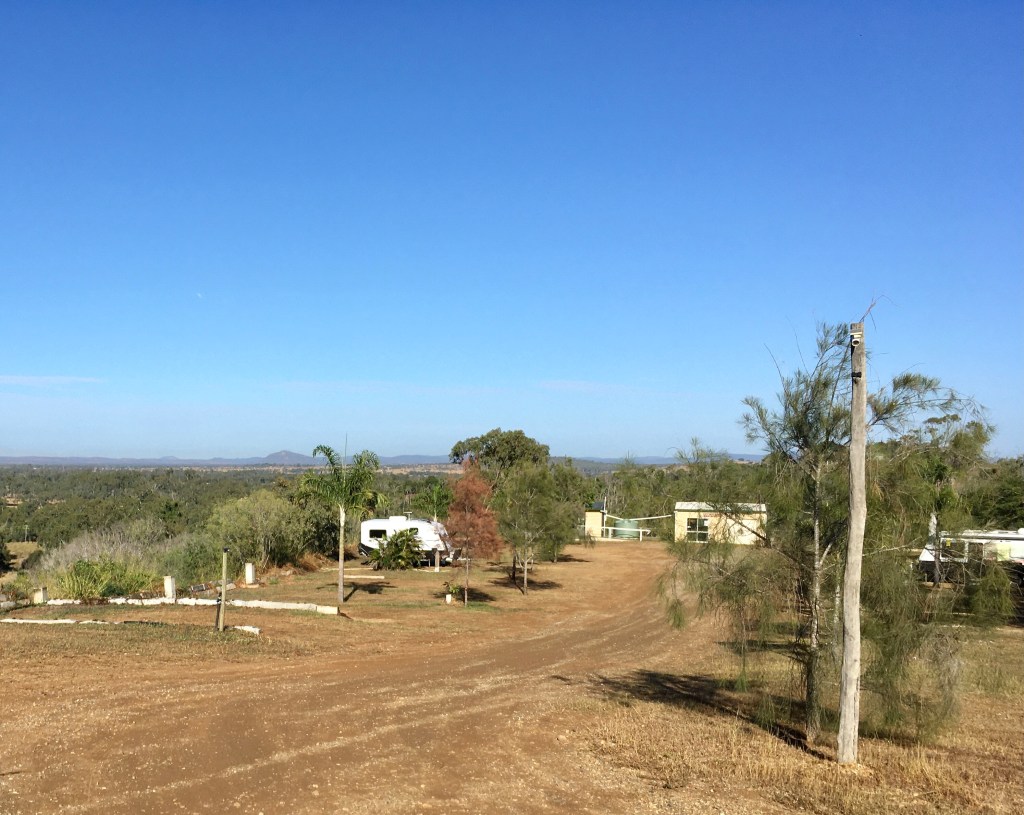
On the way to Mackay we spent a couple of nights at Fardooley’s Bush Camp, on the top of a hill about 20 km north of Rockhampton. Only a small camp, it used to be a dairy farm then beef cattle farm before it became solely a camp ground about 8 years ago. It’s basic, with about 18 camp sites, water, toilets and showers and no power but the view is good and the owners are very friendly. All guests are invited to the owners’ bar for happy hour each afternoon where we were served free hot dogs and drinks were available for a reasonable price. Good fun. We stayed for 2 nights, with fog and light rain for most of the day that we were there.
A foggy dawn at Fardooley’s Bush Camp.Fardooley’s on a sunny morning.
Next stop was 350 km away at Blacks Beach, Mackay. It appears to be the only caravan park in Mackay near the beach. We scored one of only 6 caravan sites with absolute beach frontage.
Dawn at Blacks Beach, Mackay.Sometimes it’s worth getting up early.
It’s a nice park, with quite large sites and happy hour overlooking the beach was relaxing, although not as warm as we had expected. It seems that most of Queensland is experiencing a cold spell, 23 deg here.
Preparing for happy hour on the beach.
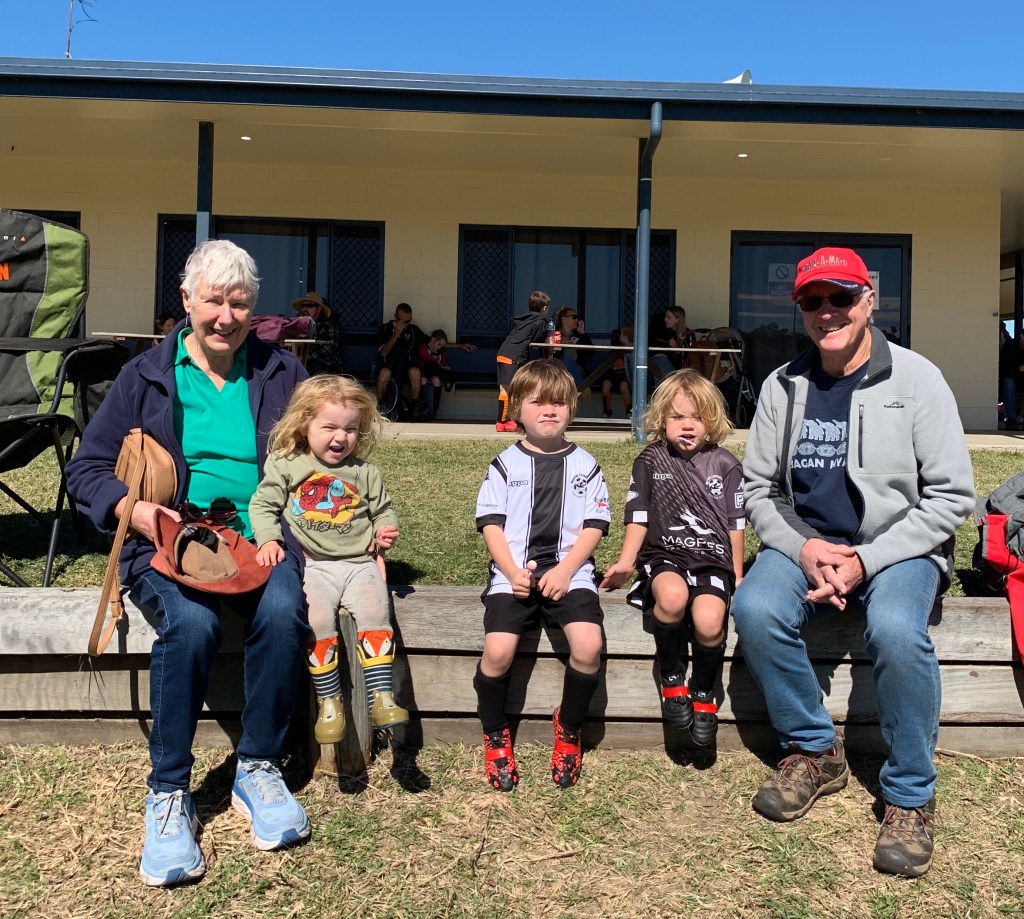
Our main reason for visiting Mackay was to see some friends who we met on the Gibb River Rd 2 years ago. We really enjoyed spending time with Kate and Ben and their 3 boys, aged 6, 4 and 2. It was good to see them every day for 4 days.
With friends at the soccer.
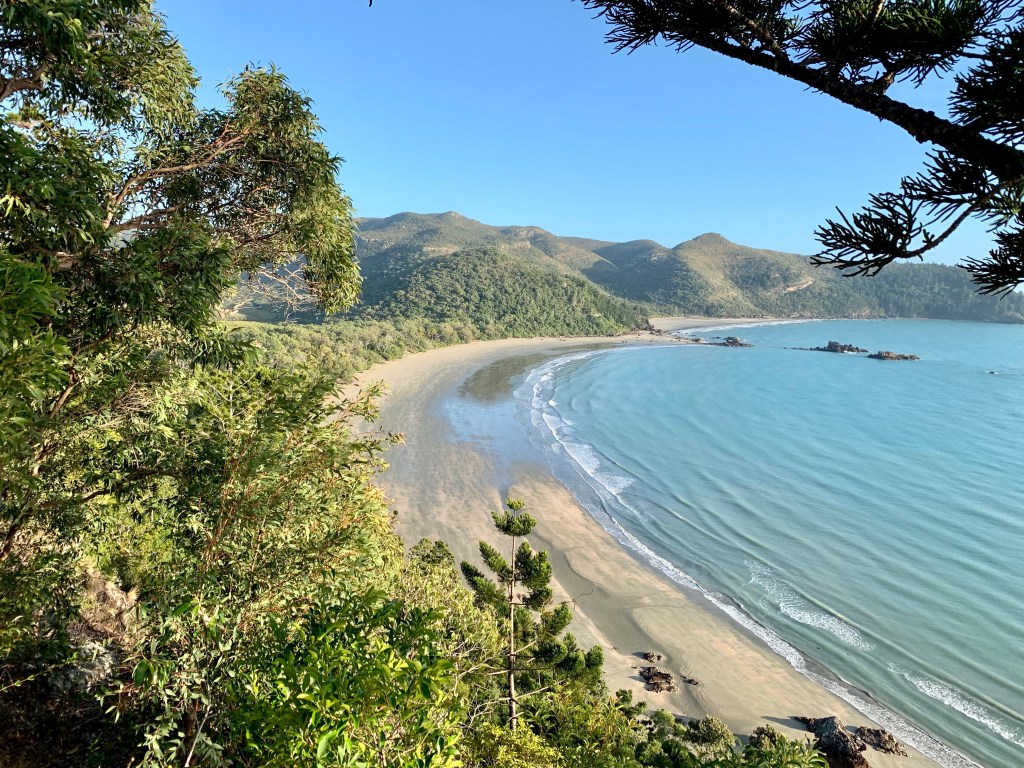
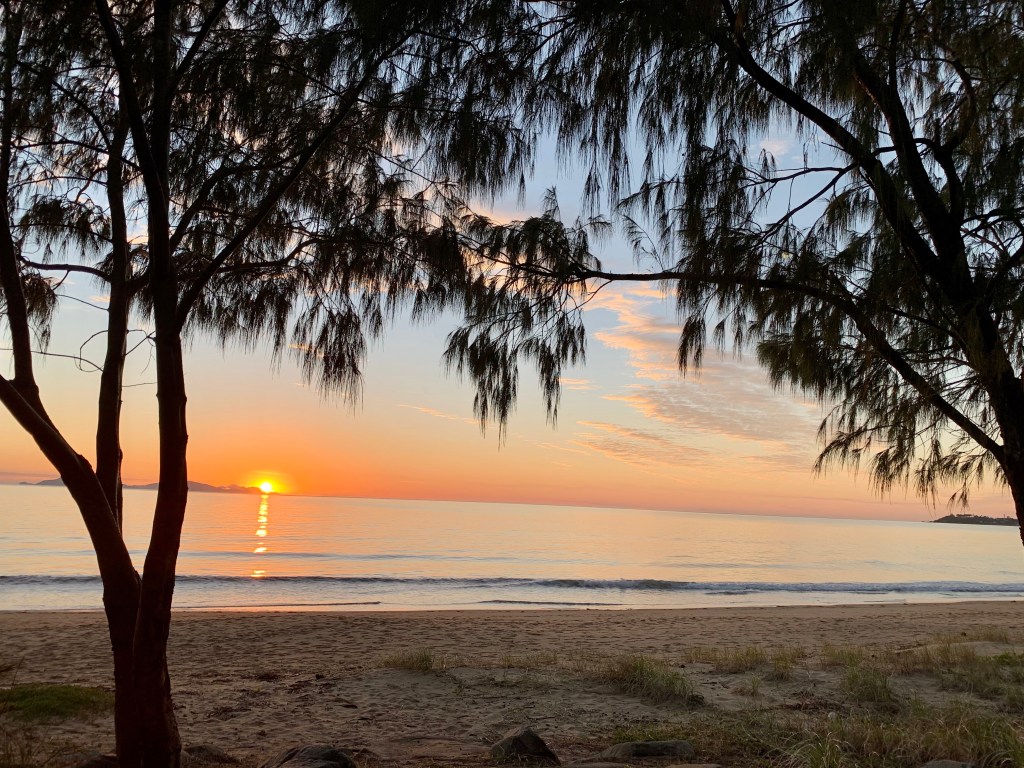
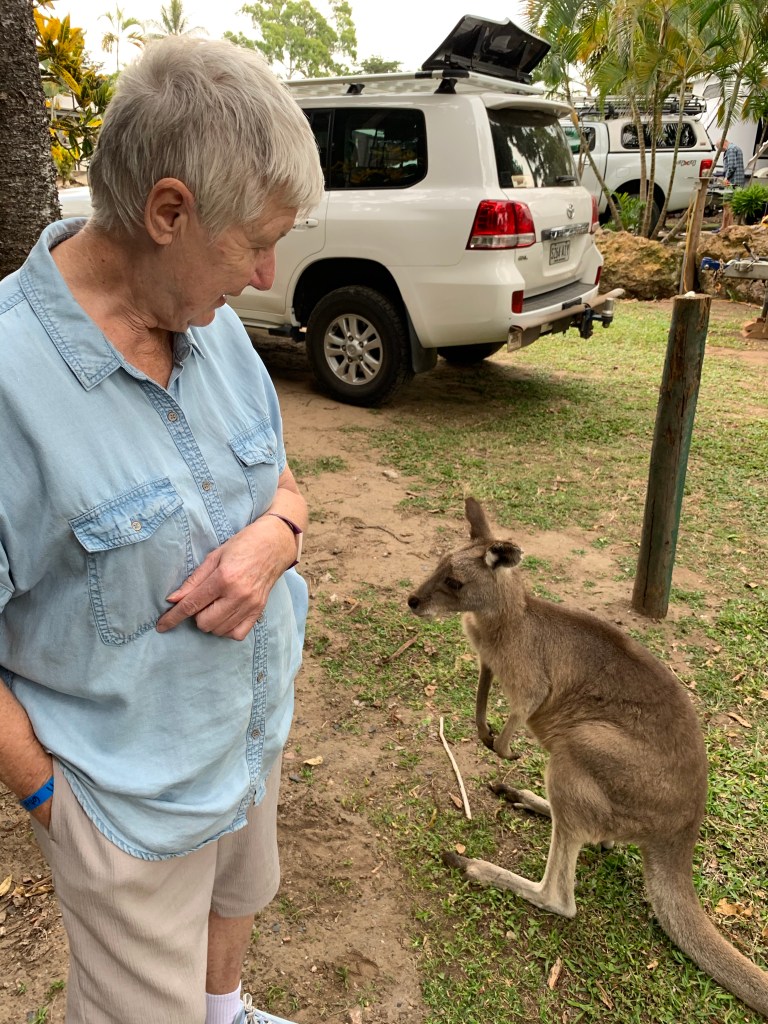
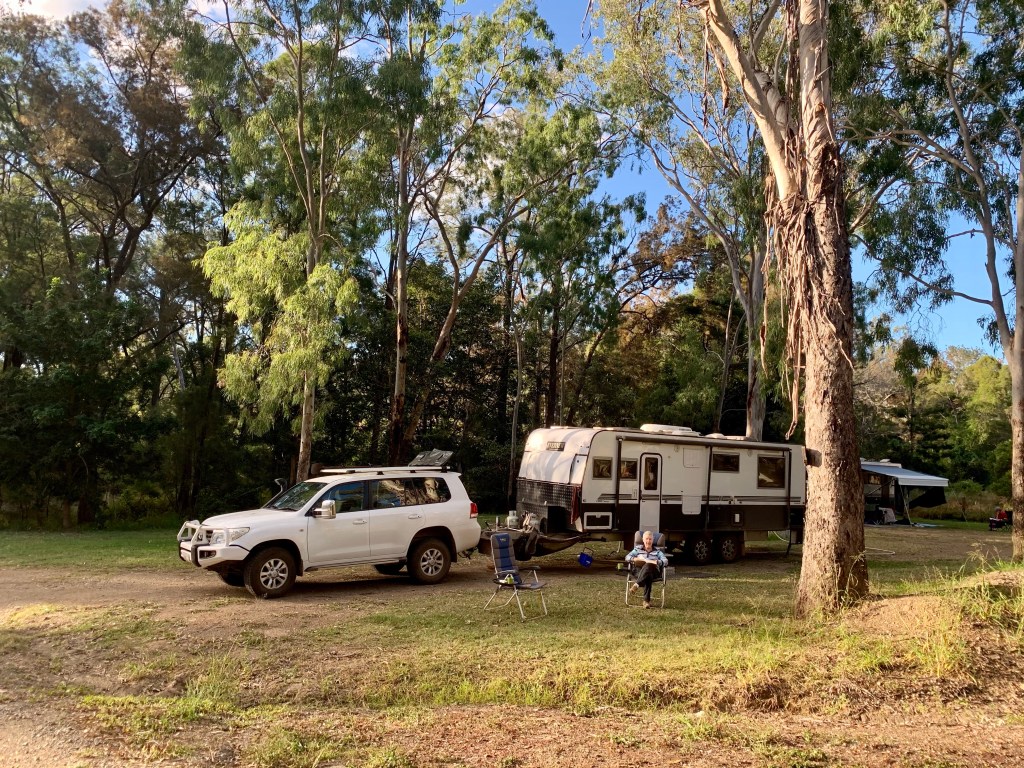
From Mackay we travelled for an hour to Cape Hillsborough caravan park, on the beach in the National,park of the same name. We can’t see the ocean from any of the sites but it’s only about 50m away and we can hear the small waves. The tide goes out a long way on the very shallow beach. Highlights here are the kangaroos in the park, wandering around amongst people, vans and tents and also on the at dawn (6am). Kookaburras are very cheeky looking for food from campers. Bush walks are another highlight, some easy and some quite steep, all through dense rainforest.
Sunrise at the beach.Frightened by a sudden noise while grazing, seeking protection from Jo.This kookaburra apparently doesn’t know that we don’t feed wildlife.A mangrove swamp at Cape Hillsborough.The rainforest became much darker than this a little further in.
This morning we’ll leave for Airlie Beach to visit more friends.
We are both well and thinking of everyone in Covid-19 stricken Victoria. It is really pleasing to hear that restrictions are being eased tomorrow and school goes back in a few days. Everyone, keep healthy and safe until we see you again.
Firstly, a note about COVID-19. When we left Adelaide two weeks ago we were so happy that Australia was in a good position. We acknowledge that people all over the world are suffering and we feel sad for them. In Australia all state borders were open and we could travel anywhere. We have both had our first vaccination and felt comfortable – and very fortunate – to be able to go on a long holiday. We knew of course that things could change at any time. Then Victoria got hit again and now that state is in quite severe lockdown conditions again and other states have again closed their borders to Victorians. We feel sad for our Victorian families and friends who are again struggling with restrictions. To all Victorians, we wish you well.
A long time ago, probably 30 years or so, we visited Fraser Island on a 2 or 3 night coach trip from Hervey Bay and enjoyed it so much that this year we decided to make Fraser Island our first target destination. It is about 2500 km from Adelaide, 10 days on the road, including 2 rest days so quite easy travelling.
Fraser Island is as good as we remembered. The largest sand island in the world, it is about 150 km from north to south by 15 km east to west, with wild ocean on the east coast and calmer sheltered waters on the west coast. The eastern beach is wide with mainly flat, firm sand at low tide making driving relatively easy and safe for a high-clearance 4WD vehicle, but at high tide driving is virtually impossible. What an amazing place it is, but more about it later.
First we had to drive through eastern South Australia, western New South Wales and south-western Queensland. After recent rains most of the countryside along the way looks good; cropping and sheep grazing in SA, sheep and feral goats (never seen so many goats) in NSW and eventually cattle, cotton and sorghum in Qld.
We camped at Mannahill rest area on the first night out of Adelaide, adjacent to the very old pub, then reached Broken Hill on day 2. At a coffee shop there I used my first aid skills to assist a 97-year old woman who had fallen in the shop and cut her head. She was lucid and seemed ok but had to wait for an ambulance. She asked if I was a doctor so I was pleased to be able to tell her that no, I am a surf lifesaver and she is the first person I’ve saved this far from the ocean.
At the border on Day 4, averaging 400 km per day.
On Day 4 we camped at a really nice camp site, beside a creek at Bollon in Qld and enjoyed our first rest day.
Very good free camp at Bollon, our van 3rd from left.
The next night we found another nice place in a national park at Lake Broadwater Conservation Park, where the lake was half full for the first time in years. Lots of swans, pelicans, ducks and cockatoos kept us company.
Lake Broadwater Conservation Park at sunrise.
We spent a couple of nights at Kilkivan Bush Caravan Park, where we had stayed a few years ago.
Kilkivan Bush Caravan Park, our second rest day.
Our neighbours at Kilkivan came from near Rainbow Beach so we picked up good information about this part of Qld before we moved on to Rainbow Beach for a night.
Then the fun started. After several days of rain in Rainbow Beach and on Fraser Island, we were told by “everyone” that the sand on the beach would be firm and we would have no trouble.
About to board the ferry at the Inskip sand bar.
Instead of deflating tires before boarding the ferry for the 10 minute ride, we decided to wait until we disembarked the ferry on the beach at Fraser Island and do it there.
On board the ferry with three trucks. It’s ominous that two are recovery vehicles.
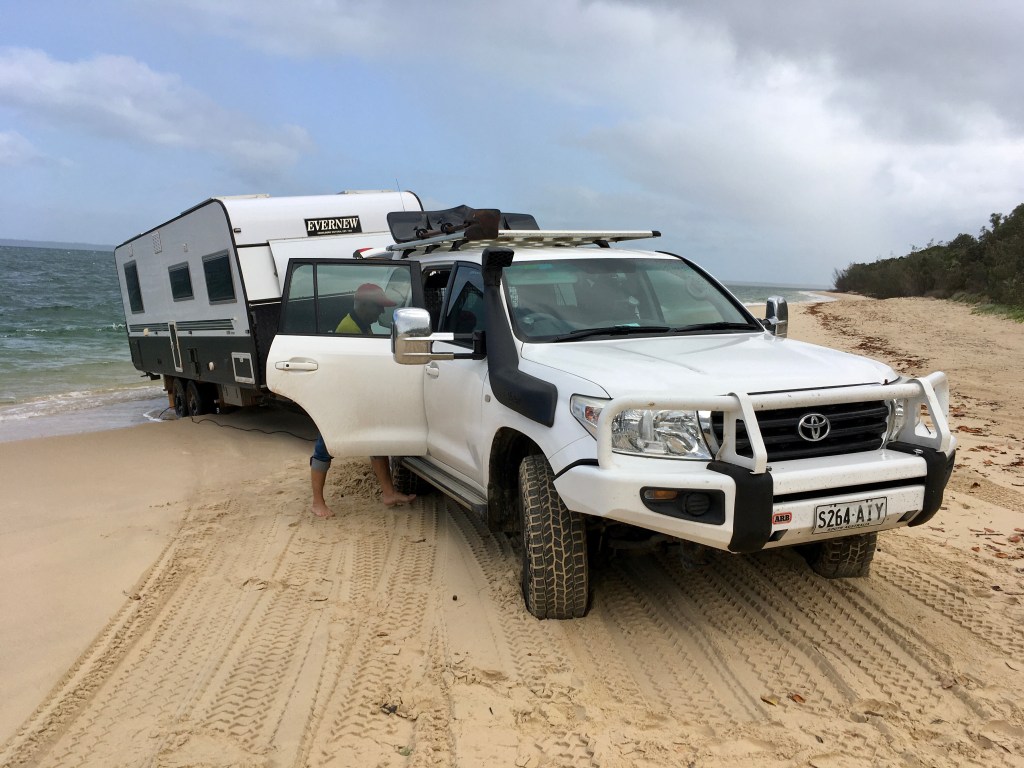
The three trucks disembarked before us, churning up the beach and guess what! – our caravan got bogged as soon as the wheels left the ferry ramp.
Bogged in a hole that the trucks had made – a bit scary.
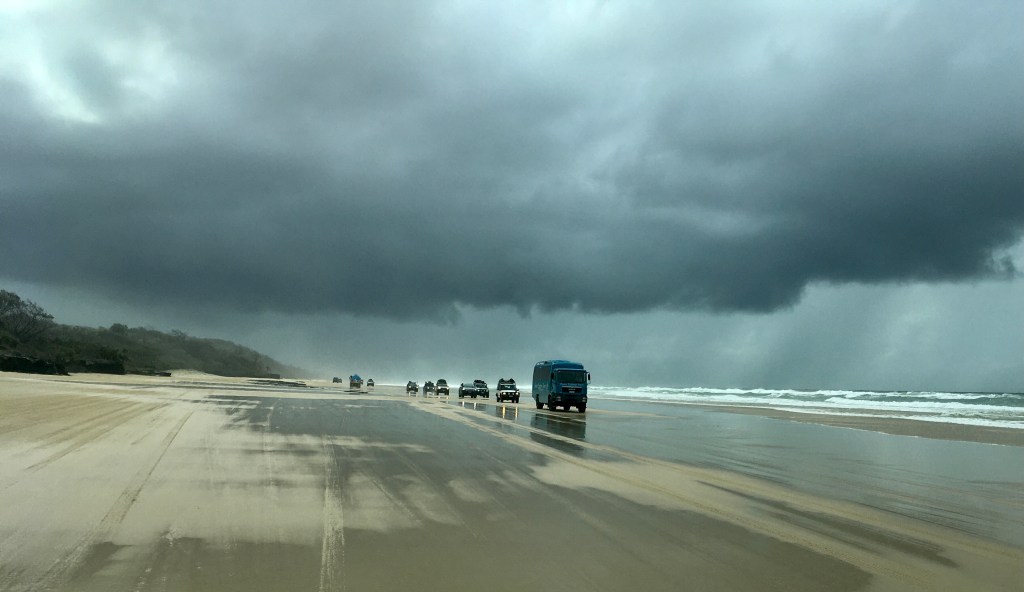
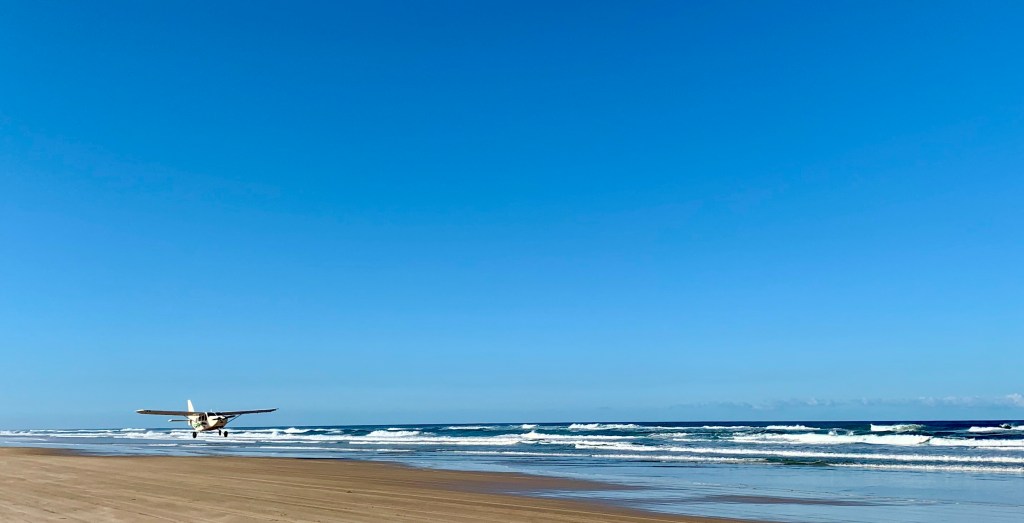
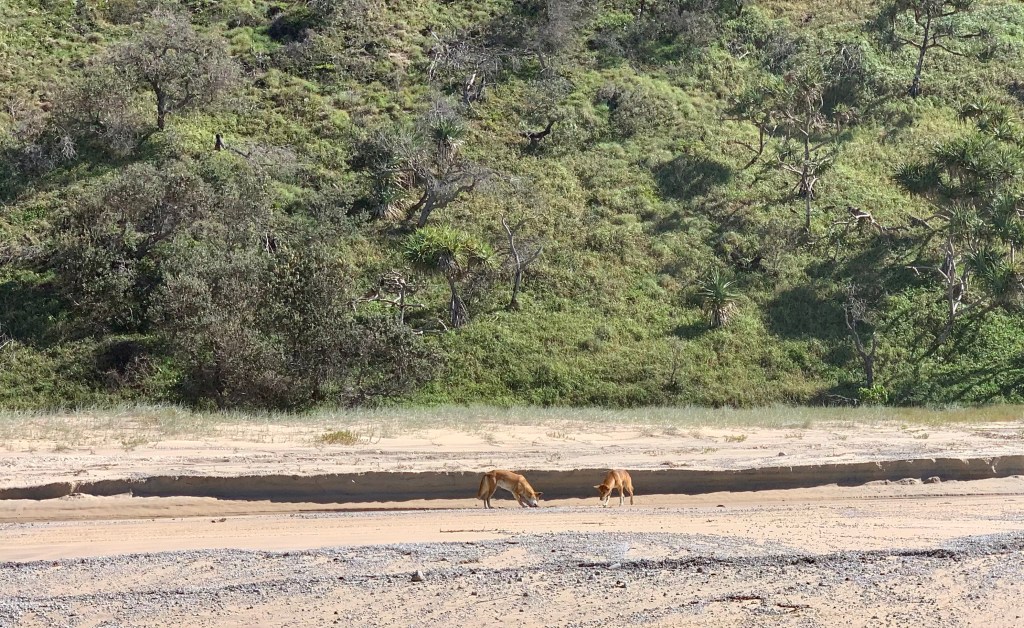
After deflating our tyres, which we should have done before boarding the ferry, and borrowing 4 max tracks, we escaped from the soft, wet sand and headed north along the firm beach. 800 people had been on the island over the weekend for a volunteer clean-up event so the beach was like a highway in the rain. We have never seen so many 4WD’s in one location. There were also a few trucks and tourist buses, even a plane using the beach for sightseeing flights – an amazing drive that included the famous dingos on the beach.
Beach driving on Fraser Island.
Photo of cars on the beach, plane taking off, dingos
Sightseeing flights use the beach as a runway.Australia’s purest strain of dingos live on the island.
Two hours later we settled in at Cathedrals caravan park, setting up between showers of rain and relaxed for our first evening. It is a beautiful park a couple of hundred metres off the beach, with trees, shrubs and green grass everywhere.
Cathedrals caravan park is spacious, but towing amongst the trees was difficult .
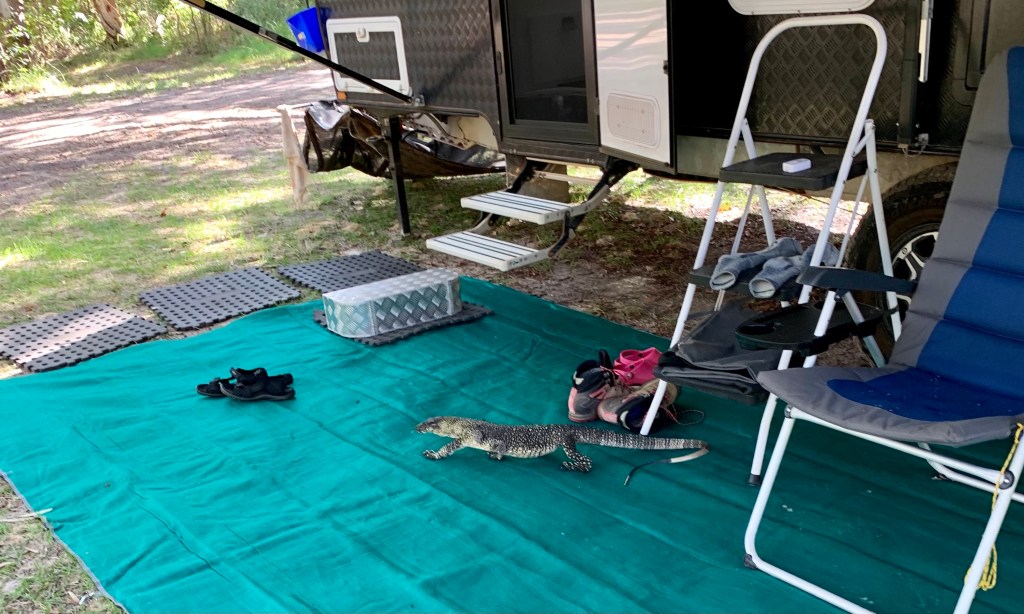
The next morning, after a visit from the local goannas, we started exploring, with an hour driving along the beach and a long drive along a rough sandy track to Orchid Beach for lunch. Oops! Lunch was not on that day so we had a pie instead. Beach and sandy track driving is good fun and we had no trouble finding our way back to the caravan park where we enjoyed a camp fire evening with neighbours.
The many goannas are not afraid of humans as they look for food.
Every Fraser Island trip involves beach and inland sandy track driving. On the second day we went along the beach to Eurong, where we stayed all those years ago, then inland to beautiful Lake Mackenzie in the centre of the island. Only 6 months ago over half the island was burnt in a huge bushfire but it has recovered at an amazing rate, due the sunshine, warmth and rain that happens in coastal Qld. Trips here take a long time because the narrow, rough tracks that allow an average speed of only about 10 kph. The scenery is beautiful, with hundreds of varieties if vegetation.
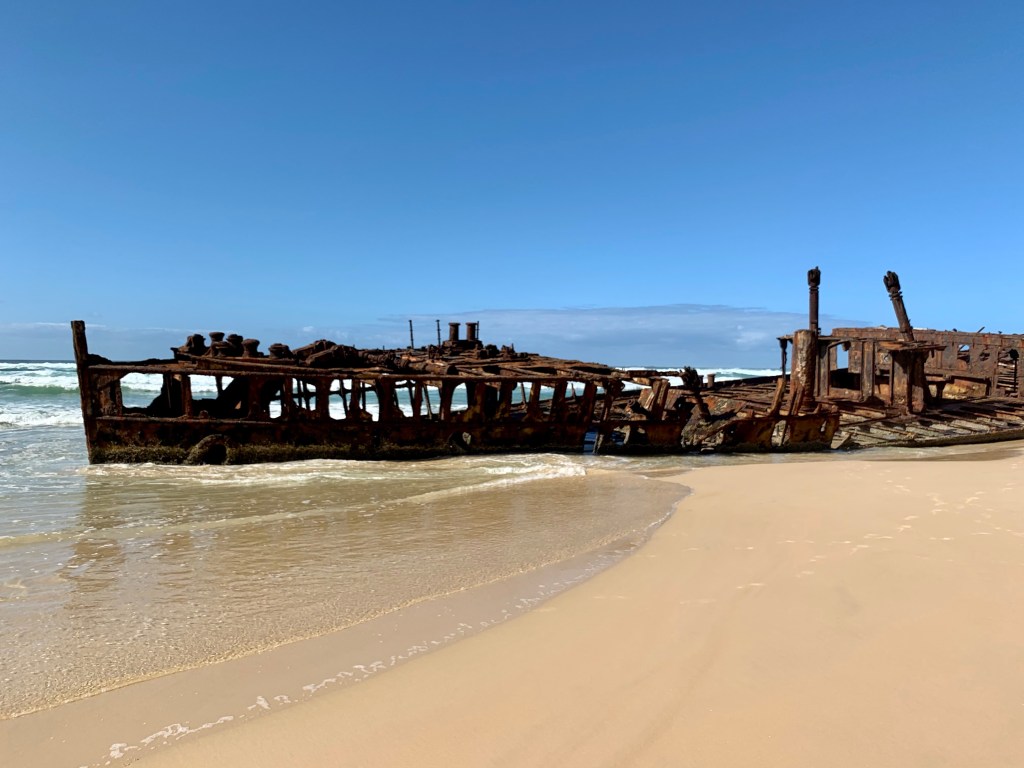
The passenger liner, Mohena, ran aground here in 1935.Beautiful Lake MacKenzie.
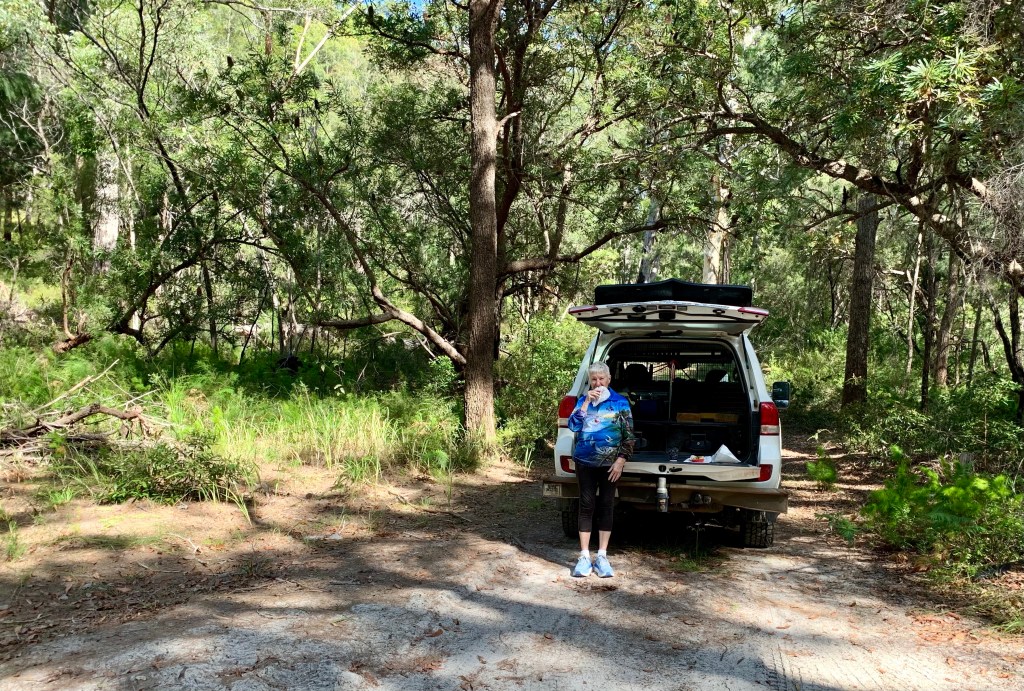
All driving needs to occur within 3 hours each side of low tide so that means paying attention to tide times. Therefore instead of having lunch in the caravan we had to buy pies and cream buns at the Eurong bakery and eat them beside the inland track; it’s a tough life.
Lunch in the rainforest restaurant.
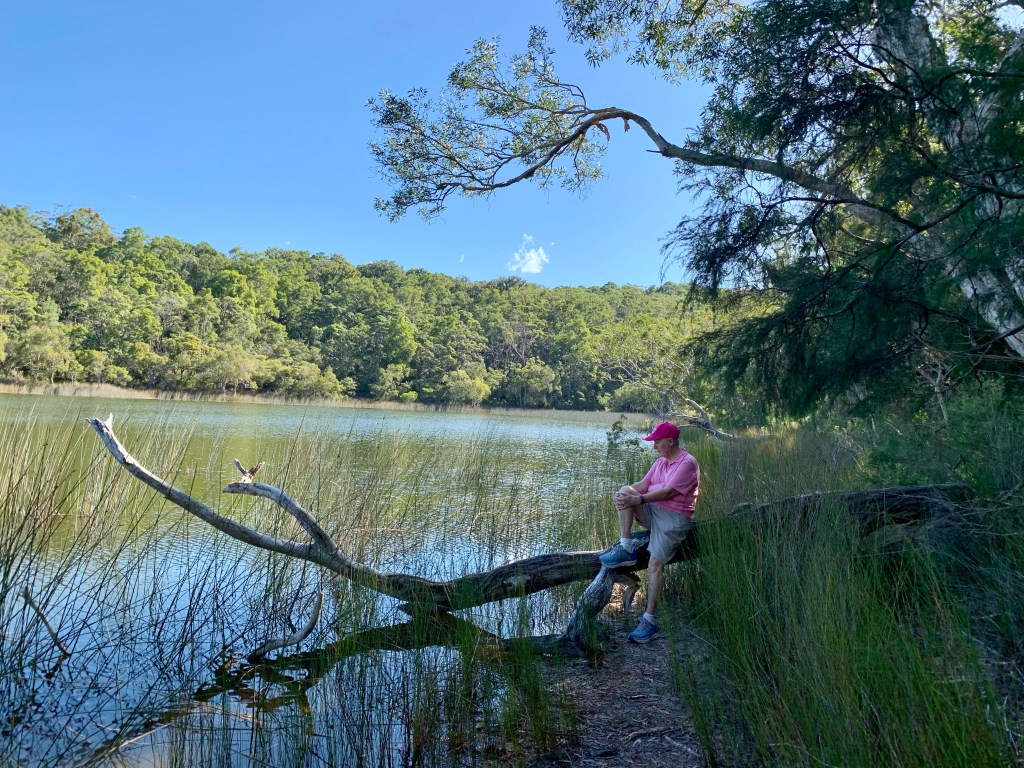
After another camp fire evening we decided to take a short drive for our 3rd day on the island. We started with hamburgers at the caravan park, then a 10 minute beach drive and a 10 km Sandy track, which took over an hour. This took us to Lake Allom, a freshwater perched lake, in sand dunes 150m above sea level where fish and turtles live in isolation from the rest of the world. It’s incredible to see nature at its best. The short drive and a bush walk took 4 hours.
Wishing our grandchildren could be with us, Lake Allom.
Unfortunately we couldn’t stay on Fraser Island any longer so, after waiting until 1.00 to catch the low tide, we drove the 80km back along the beach to Hook Point where we caught the ferry back to Inskip Point.
On the trip back to the ferry, a beautiful 22 deg day again. Waiting in the queue for the ferry.
This time, despite being a bit nervous about getting bogged again, we had no problems. The barge ramp was level and, after driving through soft sand for a few hundred metres, the sand was firm and level at the loading point. It was also good on the mainland. At Rainbow Beach we got the car and caravan washed thoroughly and checked in at the caravan park. Dinner at the surf club finished the day well.
Now we are at Hervey Bay for a couple of days, on our way to visit friends in Mackay.
It was good that we left Spear Creek earlier than we had planned because we heard as we left Laura that Port Augusta, 25 km from Spear Creek, had 100 kph winds last night and areas in the Flinders Ranges had received up to 90 ml of rain. We could have found it very uncomfortable at Spear Creek and might not have been able to get out for a couple of days. Areas to the north and east of Port Augusta haven’t received that much rain for several years so it’s good for the countryside. It rained steadily most of the way to Cadell but not enough to be a problem.
At Cadell we stayed with our friends who own Caudo Vineyard. Anyone driving near Cadell should visit the cellar door; the wines and food are great, the hosts and staff are fabulous and the setting is amazing. We had a wonderful couple of days here, at one of the nicest places we have seen anywhere along the River Murray.
What a great setting for a couple of days with friends.Customers enjoying lunch at beautiful Caudo Vineyard.
After leaving Cadell we intended staying a few days in the Clare Valley and a few days in the Barossa Valley but the weather was cold and windy, getting down to 1 degree over night, so instead we came home early. Even though we shortened our trip by two weeks we still enjoyed it and we realise that we are very fortunate to have been able to travel at all. Throughout the trip we have thought every day of the people of Victoria, including our family, who have not even been able to leave their homes for more than an hour a day. The COVID case numbers are improving daily there so hopefully the Victorian lockdowns will be relaxed soon.
As usual, here are a few statistics for those who are interested (approximate figures). During the 37-day trip we travelled 5,000 km, being 3,600 km with the caravan and 1,400 km on side trips. We relocated the caravan on 18 days at an average of 200 km each time we moved; the van did 300 km or more on 5 days and less than 100 km on 5 days. We used 1,000 L of diesel at an average cost of $1.50, making a total of $1,500, or $41 per day. Average fuel consumption was 20 L/100.
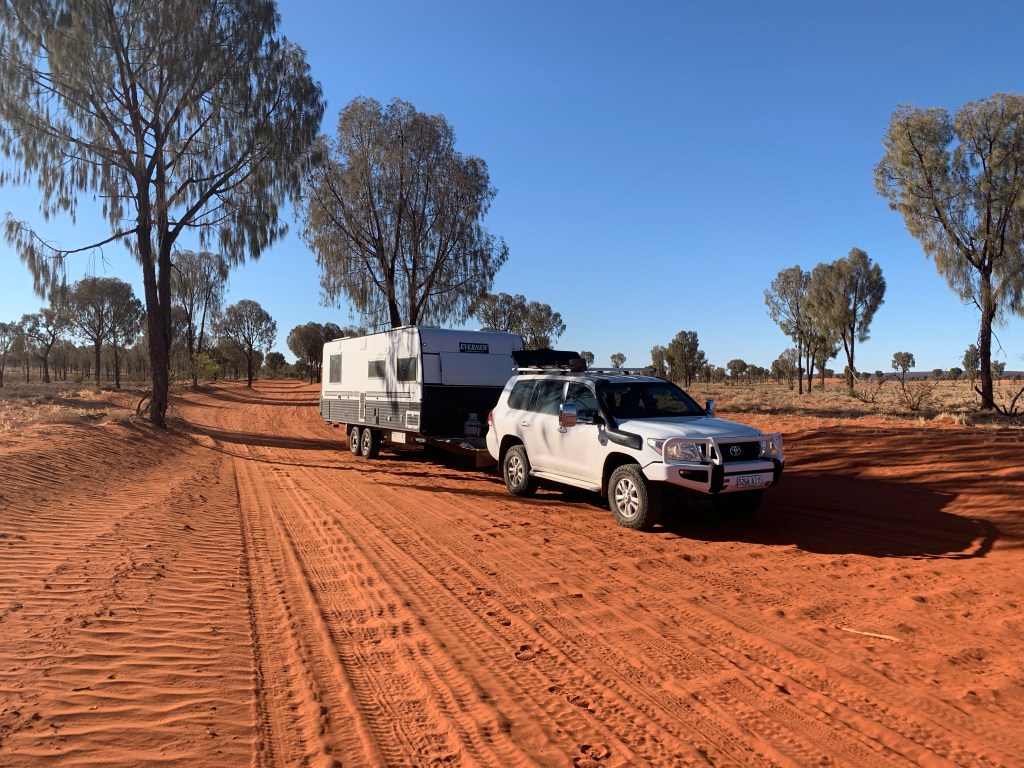
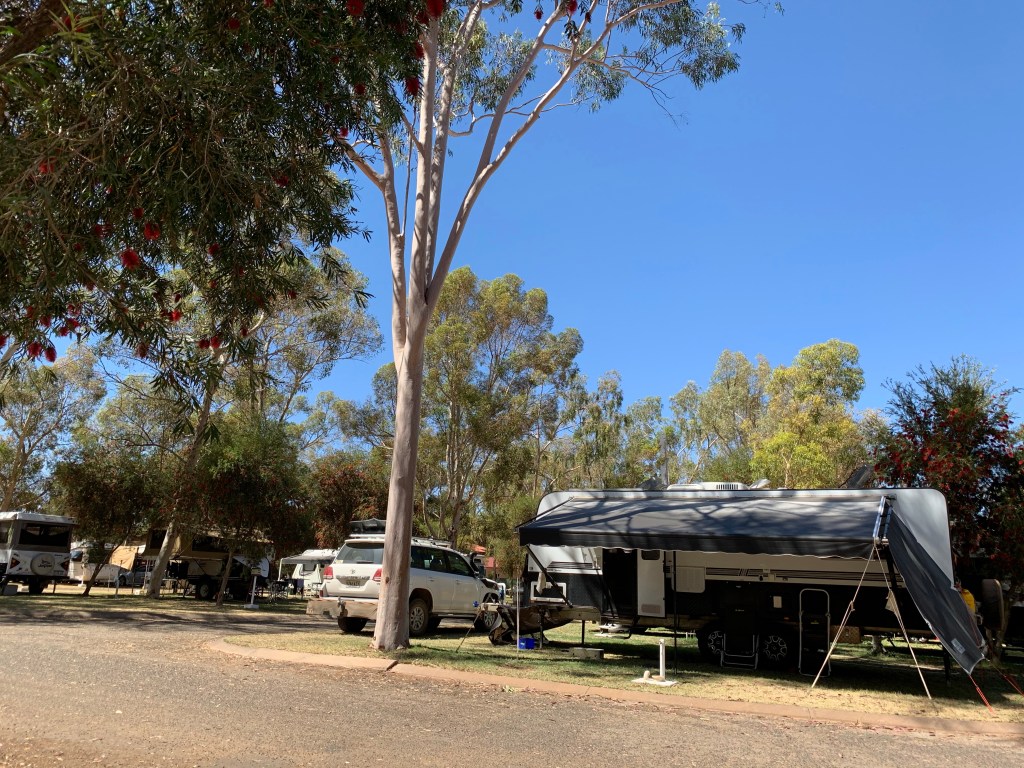
The 25 km long Rainbow Valley road – after thousands of kms on roads like this, over 4 years, no wonder the shock absorbers needed to be replaced.We don’t always camp in the bush. This is G’Day Mate park in Alice Springs.
We have no definite plans for our next caravan trip but, with luck, we might be able to go to Tasmania in 2021 to do the trip that we had planned for 2020. It depends on COVID-19.


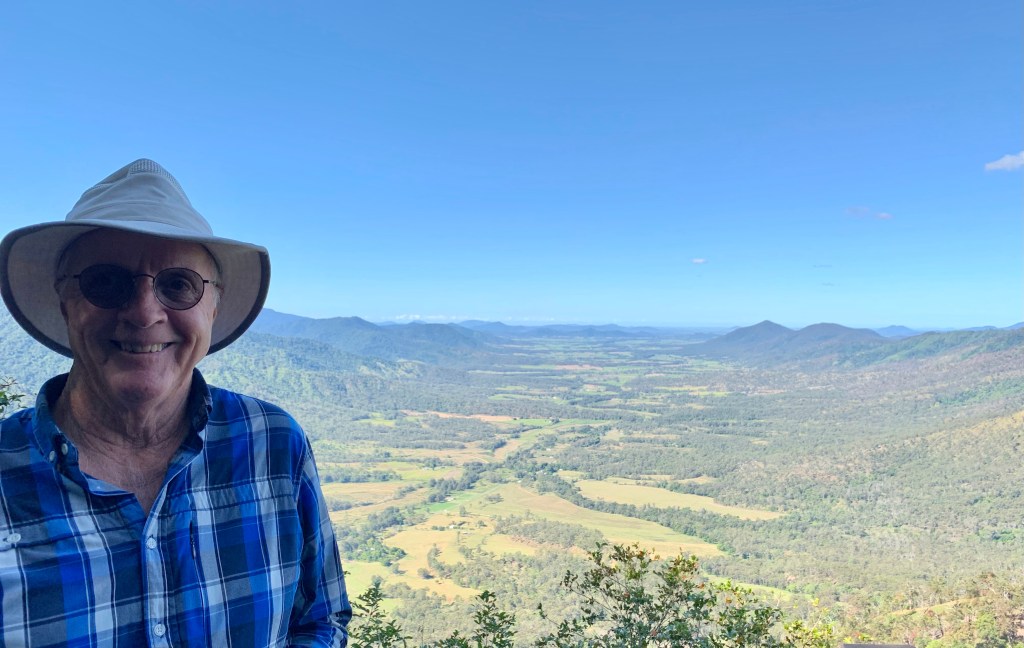



















 Ted and Jo